A Practical Guide: How to Spend Less Time on Your Phone and Reclaim Your Day
To truly spend less time on your phone, you have to get brutally honest about why and when you’re picking it up in the first place. This requires a complete breakdown of your habits. It means analyzing the data with tools like Apple’s Screen Time, but then digging deeper to find the emotional triggers—like boredom, anxiety, or stress—that lead to another hour lost to mindless scrolling. Understanding this dynamic is the first step toward lasting change.
First, Understand Your Relationship With Your Phone
Before you can build a healthier relationship with technology, you need a clear, unfiltered picture of what’s happening right now. This isn’t about judgment; it’s about gathering data. The core insight here is that you cannot change a habit you don’t understand. The goal is to shift from mindless, reactive scrolling to mindful, intentional usage, and that journey kicks off with a simple audit of your digital life.
This first step is absolutely crucial because generic advice almost always fails. The implication of a one-size-fits-all plan is that it ignores your unique triggers, daily routines, and emotional landscape. By truly understanding the why behind your screen time, you can build a personalized strategy that actually sticks.
Go Beyond the Numbers
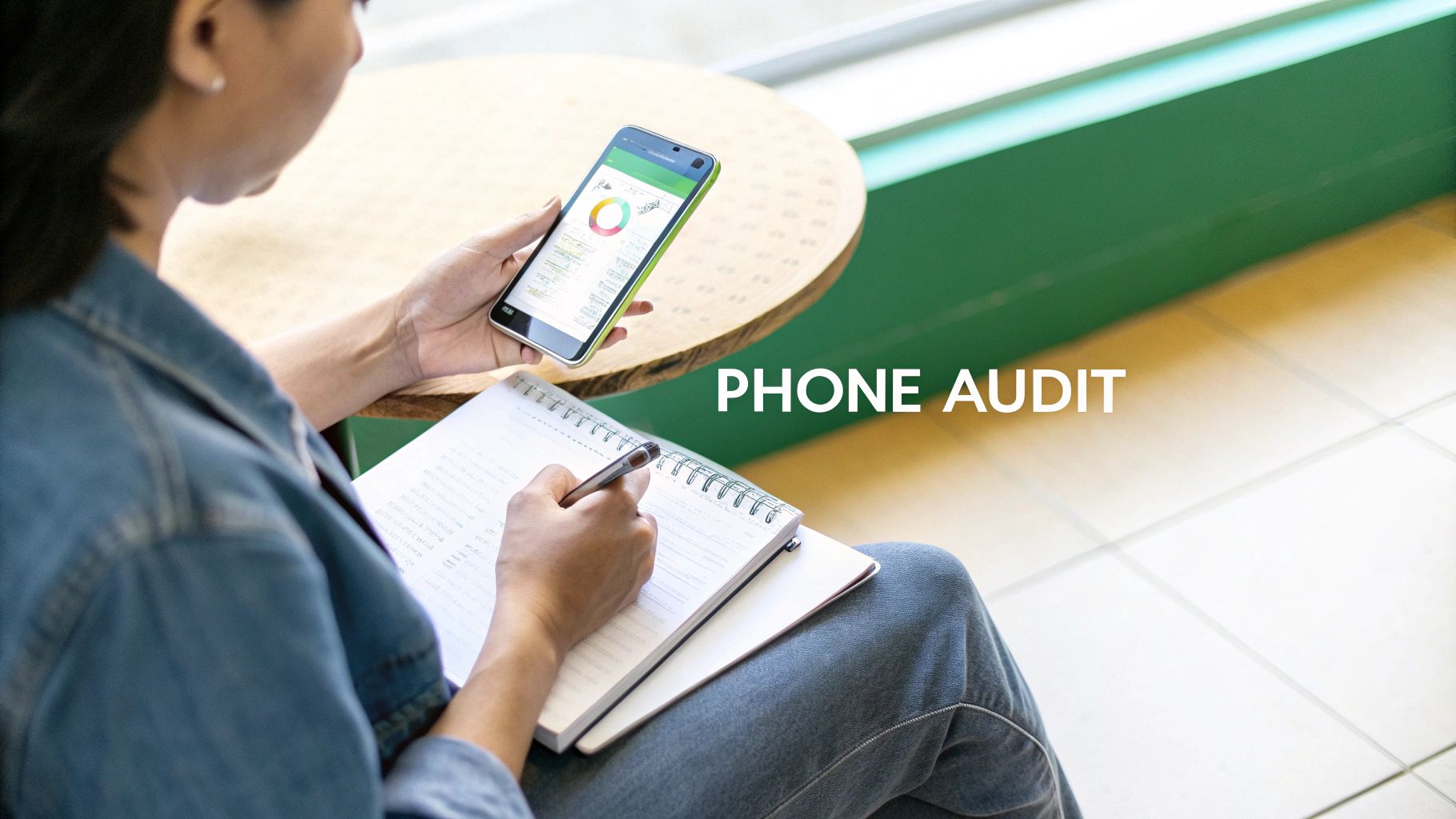
Your phone’s built-in tools are a fantastic place to start. Both Apple’s Screen Time and Android’s Digital Wellbeing give you the hard data on your habits, showing exactly how many hours you’re clocked in and which apps are eating up the most time.
But the numbers only tell part of the story. Sure, the average person spends hours a day on their smartphone, tapping or swiping it thousands of times. What’s more telling are the behavioral insights: a staggering 69% of people check their phones within five minutes of waking up. That’s not a conscious choice; it’s a deeply ingrained, almost reflexive behavior. This highlights the difference between active usage (using your phone as a tool) and passive consumption (letting your phone use you).
These stats show a widespread pattern, but your personal audit needs to uncover your specific cycle. Is your high Instagram usage a way to decompress after work, or is it a tool for procrastination? Does checking emails late at night come from a real need, or is it just anxiety looking for an outlet?
Uncover Your Emotional Triggers
The most powerful insights come from connecting your phone usage to your emotional state. Every time you reflexively grab your phone, there’s an underlying trigger. The key implication here is that your phone isn’t the problem; it’s the solution you’re using for an underlying emotional need. Figuring out what those moments are is the key to breaking the cycle.
For many of us, it’s not even a conscious decision anymore. If you’re finding it hard to pinpoint these automatic behaviors, our guide on getting help for phone addiction can offer more clarity and support.
To get started, try keeping a simple “Usage Journal” for a few days. You don’t need anything fancy—a small notebook or the notes app on your phone works perfectly.
For each significant phone session, jot down three things:
- Before: What were you feeling or doing right before you picked up your phone? (Bored, stressed, waiting in line, lonely?)
- During: What did you actually do on your phone? (Scrolled social media, checked news, played a game?)
- After: How did you feel when you put it down? (More anxious, relaxed, distracted, guilty, informed?)
To make this even easier, use this quick checklist to guide your first few days of observation. It’s designed to help you quickly spot the patterns that are holding you back.
Phone Usage Self-Audit Checklist
| Audit Question | My Answer (Yes/No/Details) | Actionable Insight |
|---|---|---|
| Do I check my phone within 15 minutes of waking up? | This points to a deeply ingrained morning habit that likely needs a new routine to replace it. | |
| Do I use my phone while eating meals, even with others? | This suggests the phone is interfering with mindful eating and social connection. | |
| Do I reach for my phone during any moment of boredom or downtime? | This indicates a low tolerance for boredom and an opportunity to find new, non-digital fillers. | |
| Does my screen time spike when I’m feeling stressed or anxious? | This identifies emotional regulation as a key trigger for phone use. | |
| Do I check social media or email right before trying to sleep? | This habit is likely impacting sleep quality and needs a new “wind-down” ritual. | |
| Do I feel a sense of anxiety if my phone is not within reach? | This points toward “nomophobia” and the need to practice intentional separation. |
This checklist isn’t about getting a perfect score; it’s about shining a light on your subconscious habits so you can start making conscious choices.
After just a couple of days, patterns will start jumping out at you. You might notice that you grab your phone every single time you feel a flicker of boredom, or that scrolling through social media actually leaves you feeling more drained and disconnected, not less.
This self-awareness is your foundation. It transforms the vague goal of “spending less time on my phone” into a specific, actionable mission. Instead of fighting a powerful habit with sheer willpower, you can now start addressing the root causes, setting yourself up for real, lasting change.
Redesign Your Phone’s Environment for Focus
Let’s be honest: your phone isn’t a neutral tool. It’s a meticulously engineered environment built from the ground up to capture and hold your attention. Every bright color, satisfying ping, and red notification bubble is a design choice intended to pull you in. The key insight is that to spend less time on your phone, you have to fight design with design. It’s all about creating intentional friction between you and your most distracting habits.
This isn’t just about willpower. Research consistently shows that relying on inner strength alone is a losing battle. The most successful people change their environment to make good choices easy and bad choices hard. The implication is clear: just having your phone in sight, even face down, can tank your cognitive performance. The mental energy you spend just ignoring it leaves less in the tank for what you actually want to do.
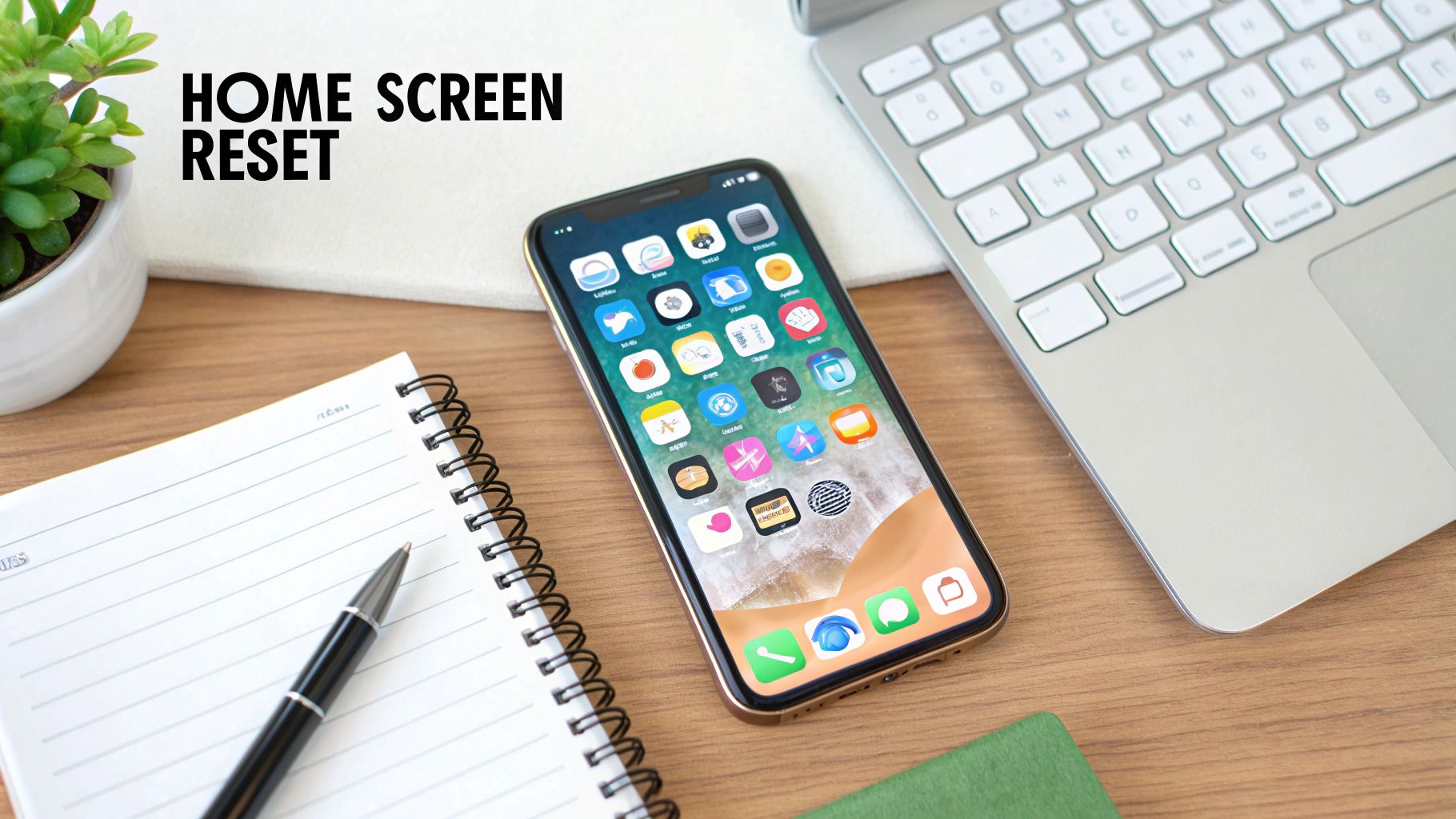
This is the starting point for a “home screen reset”—a powerful technique for reclaiming your phone’s most valuable real estate. By clearing the clutter, you start turning your phone from a slot machine back into a purpose-driven tool.
Silence the Unnecessary Noise
First up: a notification overhaul. Those constant pings and buzzes aren’t just minor interruptions; they are engineered triggers designed to hijack your focus. The goal here is to regain control. The difference is between a reactive state (your phone dictates your attention) and a proactive one (you decide when to engage).
Start by turning off push notifications for every non-essential app. Be ruthless. Do you really need an immediate alert from a news app or a social media platform? Almost certainly not. For the ones you keep, bundle them. Android’s Notification Summary and iOS’s Scheduled Summary are great for this, collecting non-urgent alerts and delivering them in a single batch once or twice a day.
- Social Media: Turn them all off. You’ll see updates when you intentionally open the app.
- Email: Disable banners and sounds. Use badges only if absolutely necessary for work, and schedule specific times to check your inbox.
- News & Retail: These are major sources of distraction. Turn off all alerts immediately. No exceptions.
This simple act breaks the reactive cycle. You stop being a puppet to your phone’s demands and start engaging on your own terms.
Perform a Home Screen Reset
Your home screen is the most valuable digital real estate you own. Right now, it’s probably a colorful, tempting minefield of your biggest time-wasters. A home screen reset flips this dynamic, turning it into a minimalist, tool-based launchpad. The benefit is transforming your phone from a source of distraction into a functional utility.
The process is simple: remove everything from your home screen except for essential, non-distracting utility apps. Think tools, not toys—apps like your calendar, notes, maps, and camera.
Move all other apps—especially social media, games, and news—into a single folder on your second or third screen. This simple act of adding a few extra taps creates just enough friction to make you pause and think, “Do I really want to open this right now?”
The difference is profound. Instead of your phone tempting you with endless distraction the moment you unlock it, it presents you with a clean slate or a set of productive tools. This encourages intentionality, a core skill for anyone trying to spend less time on their phone. Mastering this also builds a solid foundation for learning how to keep focus on work, as you’re eliminating the primary source of digital interruptions before they even start.
Drain the Color and Reduce Addiction
One of the most surprisingly effective tactics is switching your phone to grayscale mode. App designers use vibrant colors strategically to make their platforms more appealing and to guide your attention. Removing color makes your phone significantly less stimulating and, frankly, a lot more boring.
When your Instagram feed turns into a muted gray landscape, the dopamine hit is drastically reduced. Suddenly, endless scrolling feels a lot less rewarding. The implication is that you’re short-circuiting the psychological reward loop that keeps you hooked.
You can usually find this setting under your phone’s Accessibility options. It might feel strange at first, but many people find it dramatically reduces their mindless browsing within just a few days. It’s a simple environmental change that undermines the core psychological tricks used to keep you hooked.
Build a Fulfilling Life Beyond the Screen
Changing your phone’s settings is a great defensive move, but it’s only half the battle. When you just put your phone down, you create a void. Your brain hates a vacuum, and it’s incredibly good at finding reasons to pull you right back into scrolling.
The real key to learning how to spend less time on your phone is to fill that new space with meaningful, engaging activities. This isn’t about restriction; it’s about proactively building a life that’s genuinely more interesting than the endless scroll. The benefit is not just less screen time, but a richer, more engaged life.

Identify Your Phone’s True Purpose
Before you can find replacements that stick, you need to get honest about what needs your phone is currently meeting. It’s almost never just about “wasting time.” Your phone use serves a purpose, even if it feels mindless.
Think back to the audit you did earlier. What was the emotional driver behind the scroll?
- Connection: Were you scrolling through social media feeds when you felt a pang of loneliness?
- Entertainment: Was YouTube or a mobile game your default escape from boredom?
- Stress Relief: Did you open a news app or browse online shops to numb feelings of anxiety?
Once you pinpoint these underlying drivers, you can start looking for healthier, offline alternatives that scratch the same itch. The goal isn’t to deprive yourself but to upgrade your sources of fulfillment.
Craft Your Replacement Habits
Once you know the why, you can get strategic about the what. This is where you swap screen time for real-world engagement. The secret is to start small and make the new habit just as easy—or even easier—than grabbing your phone.
The idea is to create a one-to-one swap. A vague goal like “read more” is useless. Instead, create a specific, trigger-based plan. For example: “When I feel the urge to check social media after dinner, I will pick up the novel on my coffee table instead.” This is a key comparison: swapping a low-value habit for a high-value one.
Here are a few practical swaps based on common triggers:
- If you scroll to de-stress: Swap 15 minutes of doomscrolling for a short walk around the block, listening to a favorite album, or doing a few simple stretches.
- If you browse out of boredom: Keep a book, a crossword puzzle, or a sketchbook within arm’s reach. The moment boredom hits, your replacement is ready to go.
- If you seek connection: Instead of scrolling through feeds, schedule a quick five-minute phone call with a friend. The real-time interaction is infinitely more rewarding.
There’s an old Hindu proverb, “You worship what you sit next to,” that is incredibly relevant here. If your phone is always the closest object, it will get your attention. By physically placing a book, a guitar, or a journal next to you, you’re consciously choosing what to prioritize.
Rediscover the Power of Hobbies
One of the biggest casualties of excessive phone use is the time we once dedicated to hobbies and deep interests. The implication of constant connectivity is that it crowds out activities requiring deep focus. So many people I talk to feel they “don’t have time” for hobbies, yet their screen time reports show hours of available time each week.
Reclaiming that time means rediscovering activities that engage your hands and your mind. To truly spend less time on your phone, you need to fill your life with engaging alternatives. You could even explore some thrilling outdoor adventure activities, which provide a powerful reset and remind you of the rich experiences available beyond a screen.
It doesn’t have to be extreme, though. Just think back to what you enjoyed before smartphones took over.
- Creative Pursuits: Try painting, writing, playing a musical instrument, or gardening. These activities provide a tangible sense of accomplishment that digital consumption rarely offers.
- Physical Activities: Join a local sports league, take up hiking, or start a regular yoga practice. Moving your body is a proven antidote to the mental fatigue caused by screen overload.
- Learning a Skill: Dedicate 20 minutes each day to learning a new language, coding, or cooking a new recipe. The process of acquiring a skill builds confidence and provides lasting satisfaction.
Building a fulfilling offline life isn’t about adding more to your to-do list. It’s about being intentional with the time you already have, swapping low-quality digital distractions for high-quality, real-world experiences that genuinely nourish you.
Set Clear Boundaries with Yourself and Others
Taming your phone use isn’t just about what you do on your phone; it’s about fundamentally changing the rules of engagement. This is where you draw a line in the sand. Setting firm boundaries is how you protect your most valuable resources—your time and attention—from the endless pings and social pressures that keep you tethered to a screen. The benefit is clear: you move from a reactive state, where a notification dictates your next move, to a proactive one where you’re in the driver’s seat. It’s about carving out sacred, screen-free space in your day for your mind to breathe and connect with the world right in front of you.
Create Phone-Free Zones and Times
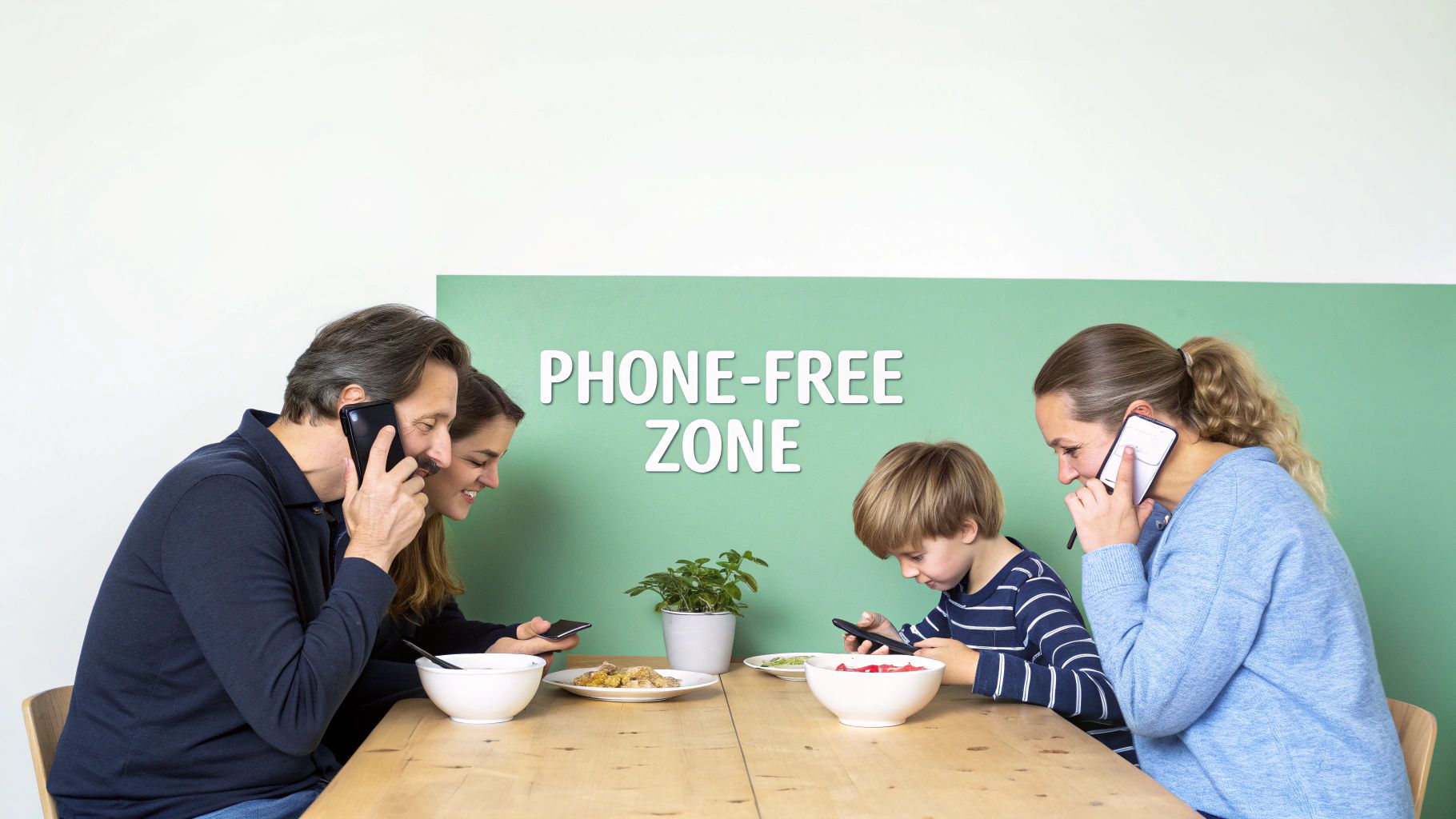
The easiest way to make new rules stick? Build them into your environment. When you designate specific areas and times as explicitly “phone-free,” you don’t have to rely on sheer willpower to resist temptation. Your brain just learns to associate these contexts with being unplugged.
Here are the non-negotiables:
- The Bedroom: This is the big one. As relationship expert Esther Perel wisely points out, if the first and last thing you touch each day is your phone, you’re not building a healthy relationship with yourself or anyone else. Go buy an old-school alarm clock and charge your phone in another room. This one change can radically improve your sleep and kill that morning scroll anxiety.
- The Dinner Table: Make mealtimes a sanctuary for actual connection. Whether you’re with family or eating solo, putting the phone away lets you be present, actually taste your food, and engage with the people around you without that digital third wheel.
- The First Hour of Your Day: Don’t let your inbox or social media feed set the tone for your day. Give yourself the first 30-60 minutes to do something analog—journal, stretch, make coffee, or just sit in silence. Starting your day with intention, rather than in a reactive panic, is a game-changer.
Angela Duckworth, author of Grit, nails it when she says that successful people don’t just have more willpower. They design their environment to make the right choice the easy choice.
Communicate Your New Boundaries
Let’s be honest: one of the toughest parts of this is social pressure. We’ve all been conditioned to believe that an instant reply is a sign of respect or productivity. To get your time back, you have to gently, but firmly, reset those expectations with friends, family, and colleagues.
This doesn’t require a dramatic public service announcement. It’s all about simple, clear communication.
For example, when you’re with someone and want to be fully present, try saying:
- “I’m going to put my phone away while we catch up. I’m trying to be better about being present.”
- “Just so you know, my notifications are off so I can really focus on our conversation.”
These statements aren’t confrontational at all. They frame your actions in a positive light, showing your desire for deeper connection. Most people won’t just respect it; they’ll probably admire it.
Tactical Boundary-Setting Scenarios
Anticipating the moments your boundaries will be tested is half the battle. By having a plan, you can replace a mindless, default reaction with a mindful, intentional strategy. This table breaks down a few common scenarios where your phone habits are put to the test, offering a clear comparison between high-use and low-use strategies.
| Scenario | Default Reaction (High Phone Use) | Intentional Strategy (Low Phone Use) |
|---|---|---|
| A friend texts while you’re focused on a task. | Immediately stop work to check the message and reply, completely breaking your concentration. | Let the notification wait. Finish your task and respond during a designated break. |
| You’re at dinner and your phone buzzes on the table. | Pick it up “just to see who it is,” pulling your attention away from the meal and your company. | Keep your phone in your bag or pocket on silent. Engage fully with your meal and companions. |
| Waiting in line at a coffee shop for two minutes. | Instinctively pull out your phone to scroll through social media or check emails. | Use the moment to just be. Look around, take a few deep breaths, or simply let your mind wander. |
| Feeling a moment of anxiety or social awkwardness. | Reach for your phone as a social “pacifier” to escape the uncomfortable feeling. | Acknowledge the feeling without judgment and resist the urge to escape. It’s temporary and it will pass. |
These small shifts from a default reaction to an intentional strategy are what build momentum.
Ultimately, setting boundaries is an act of self-respect. It’s a declaration that your time, your focus, and your real-world connections are far more valuable than the endless stream of digital noise fighting for a piece of you.
Staying the Course and Bouncing Back from Setbacks
Building a healthier relationship with your phone isn’t something you achieve and then forget about. It’s an ongoing practice. The strategies you’ve put in place are fantastic, but long-term success really comes down to how you adapt, keep the momentum going, and—most importantly—handle the inevitable slip-ups with curiosity instead of guilt. The key insight is to think of it less like a finish line and more like a continuous journey.
Let’s be real: the path to spending less time on your phone isn’t a straight line. You’re going to have days where you fall back into old habits, especially during a stressful week at work or a lazy, unstructured weekend. Accepting this from the get-go is the secret to building resilience.
Look Beyond Just the Screen Time Numbers
While your phone’s built-in analytics are a decent starting point, raw screen time hours don’t paint the full picture. A two-hour video call catching up with family is a world away from two hours of mindless doomscrolling. The key difference is quality over quantity. Real progress is measured by how you feel, not just by what the clock says.
To get a true sense of how you’re doing, start paying attention to the qualitative shifts. At the end of each week, check in with yourself and ask a few simple questions:
- How’s my focus? Can I get lost in a task for longer periods without instinctively reaching for my phone?
- How am I sleeping? Is it getting easier to drift off? Am I waking up feeling more rested?
- How are my relationships? Do I feel more present and tuned-in during conversations with the people I care about?
- How’s my mood? Do I feel generally less anxious or overwhelmed than I did before?
These are the real benefits. They reflect a genuine improvement in your quality of life, which is a much stronger motivator than just trying to hit an arbitrary screen time number.
Use a Weekend Digital Detox as a Reset Button
Sometimes, the best way to keep moving forward is to hit the reset button. A Weekend Digital Detox is an incredibly powerful tool for just that. It’s about intentionally unplugging for 24 or 48 hours to break the cycle of constant connectivity and remember what it feels like to just be in the offline world.
This isn’t a punishment—it’s a refreshing break that reminds you why you started this in the first place. For a more structured plan, you can check out our comprehensive guide on how to do a digital detox to walk you through it.
This idea of taking intentional breaks is becoming more critical than ever. With forecasts showing over 7.4 billion smartphones in use by 2025, and with 70% of the global population owning a mobile phone, these devices are woven into the fabric of our lives. The implication of this widespread adoption is that encouraging regular detox periods is a key strategy for the 5.78 billion unique mobile users worldwide to find a healthier balance. You can dig into more of these global digital trends over at DataReportal.com.
Reframe Setbacks as Learning Opportunities
If you take one thing away from this section, let it be this: a relapse is not a failure. It’s just data. If you find yourself losing an entire Sunday afternoon to scrolling, don’t beat yourself up. Instead, get curious.
Treat the moment like a scientist. Ask yourself: What triggered this? Was I feeling bored, lonely, or stressed? Did a specific notification pull me in? Understanding the ‘why’ behind a setback gives you the exact information you need to adjust your strategy.
For instance, if you realize loneliness was the culprit, your new game plan might be to proactively schedule a coffee date with a friend for the following weekend. If it was sheer boredom, maybe you could place a book or a puzzle in the exact spot on the couch where you tend to scroll the most.
This approach transforms guilt into a constructive learning moment. It ensures that every step you take—even the ones that feel like a step backward—is actually moving you forward on your journey.
Your Questions Answered: Navigating the Nuances of Phone Use
Even with the best plan, you’re going to have questions. This journey is personal, and real life has a way of throwing curveballs at our best intentions. Let’s tackle some of the most common hurdles people run into when they decide to reclaim their time from their screens.
What if My Job Requires Me to Be on My Phone?
This is easily the most common and completely valid concern I hear. For many of us, our phones are non-negotiable professional tools. Total disconnection simply isn’t an option.
The goal here isn’t elimination; it’s intentionality. The real trick is to draw a firm line between your work life and your personal life, even when they’re happening on the same small screen. The key difference lies in segmenting your digital environment.
Your phone’s built-in modes are surprisingly powerful for this. Start using “Focus” on an iPhone or the “Work Profile” on an Android to create two distinct digital worlds. During work hours, your “Work” mode can let notifications from Slack and your email come through while silencing Instagram and your group chats. After 5 PM, it flips. Work apps go silent, and you can be fully present with your family and friends.
Another game-changer is a technique called “app batching.” Instead of letting every single email or message ping derail your focus, you designate specific times to check them. A great starting point is once an hour, on the hour. You can let your team know with a simple line in your email signature or Slack status: “To focus on deep work, I check messages at 10 AM, 1 PM, and 4 PM. If something is truly urgent, please call.” It’s a small adjustment that allows you to be productive and responsive without being chained to your device all day.
How Long Until I Actually Feel the Benefits?
Everyone’s timeline is a little different, but most people are surprised by how quickly they start feeling tangible benefits. The changes tend to roll in stages, offering a breakdown of expected outcomes.
- Within the First Week: You’ll almost certainly notice an immediate improvement in your sleep, especially if you’ve kicked your phone out of the bedroom. You might also feel a little more present in conversations, no longer fighting that reflexive urge to glance at your screen.
- Within Two to Three Weeks: This is when your new routines—like that phone-free first hour of the day—start to feel less like a chore and more like second nature. The mental rewards really kick in here. Expect better focus, a noticeable drop in that low-grade background anxiety, and a surprising amount of reclaimed time.
- After One Month: The cumulative effects can be profound. This is often where your entire relationship with technology begins to shift. You start seeing your phone as a tool you command, not a device that commands you. The desire to scroll endlessly fades, replaced by a conscious choice to engage.
Honestly, the biggest change for most people is a feeling of mental clarity. When you cut out the constant stream of low-value digital noise, you finally make space for your own thoughts, your creativity, and your connection to the world right in front of you.
I’ve Tried and Failed Before. How Is This Different?
That feeling is incredibly common and frustrating. You start with great intentions, but a week later, you’re right back to your old habits. So why do so many attempts fail?
Most past efforts fail for one simple reason: they focus almost entirely on restriction (“don’t use your phone”) without a plan for what to do instead. This creates a vacuum that willpower alone can never hope to fill for long.
This approach is different because it’s built on a more complete, three-part strategy:
- We Started With Your “Why”: We didn’t just tell you to turn off notifications. We started by having you audit your usage to figure out the emotional triggers driving the behavior. Knowing you scroll out of boredom versus loneliness versus stress is the key to finding a solution that actually sticks.
- We Redesigned Your Environment: We focused on practical, tactical shifts to your phone’s setup, like resetting your home screen and using grayscale mode. These strategies add helpful friction, making it just a little harder to fall into old patterns and much easier to make a conscious choice.
- We Built Positive Replacements: This is the most critical piece of the puzzle. Instead of leaving a void, we emphasized proactively building a fulfilling offline life. By actively planning what you will do with that time—read a book, call a friend, start a new hobby—you’re not just fighting an old habit. You’re building a new, more rewarding one.
This holistic method goes beyond a simple test of willpower. It gets to the root causes, reshapes your environment for success, and fills the space you create with things that genuinely make your life better. That’s how you make lasting change not only possible but sustainable.
Ready to take the next step toward a healthier digital life? At Digital Detox App Hub, we’ve created a hub of simple, free tools to help you build better habits one small step at a time. Whether you need a plan for a weekend detox or help setting mindful boundaries, we have a focused app to guide you. Discover your path to digital balance today at https://digitaldetoxapp.com.