8 Powerful Habit Stacking Examples to Transform Your Routine in 2026
Unlocking Your Potential: The Simple Science Behind Habit Stacking
Building better habits often feels like an uphill battle against willpower. Habit stacking offers a smarter, more strategic approach by linking a new, desired behavior to one you already do automatically. This simple formula, popularized by James Clear, leverages established neural pathways, making the new habit feel less like a chore and more like a natural extension of your existing routine. Instead of relying on motivation, you rely on momentum.
This article provides a curated collection of actionable habit stacking examples tailored for busy professionals, students, parents, and anyone looking to improve their relationship with technology. We will move beyond simple lists and offer a deep strategic analysis for each example. You will learn not just what to stack, but why it works and how to adapt it to your specific goals, from boosting productivity to reducing screen time.
The core principle is to anchor your new habit to a solid trigger. For example, instead of vaguely promising to meditate more, you stack it: “After I pour my morning coffee, I will meditate for one minute.” This transforms an existing action (pouring coffee) into an unmissable cue for the new one. To truly unlock your potential with habit stacking, it’s essential to understand the core principles of habit formation and learn how to build good habits that actually stick. The following examples will provide you with a practical roadmap to implement this powerful technique immediately, helping you build a system for continuous personal growth with minimal friction.
1. Morning Coffee + Meditation
Pairing your morning coffee ritual with a short meditation session is a foundational habit stack, leveraging a highly automatic behavior (making coffee) to anchor a new, beneficial one (mindfulness). The sensory cues of grinding beans, the aroma, and the warmth of the mug become powerful triggers for your meditation practice, making it feel less like a chore and more like a natural part of your morning flow.
This particular stack is one of the most effective habit stacking examples because it transforms idle time into an opportunity for mental clarity. Instead of scrolling through your phone while the coffee brews, you create a space to ground yourself before the day’s digital deluge begins.
Strategic Breakdown
- Trigger: The process of making coffee (grinding beans, pouring water, waiting for it to brew).
- Micro-Action: A 5 to 10-minute guided or silent meditation.
- Timing: Immediately after starting the coffee maker or while waiting for it to cool.
- Ideal For: Busy professionals, parents, and anyone seeking to start their day with intention rather than digital reaction.
Key Insight: This stack works by hijacking an existing dopamine loop. Your brain already anticipates the reward of coffee. By inserting meditation just before that reward, you begin to associate the calm focus of mindfulness with the pleasant feelings you get from your morning brew.
Actionable Takeaways
To implement this habit stack effectively, focus on minimizing friction. The goal is to make meditating easier than not meditating.
- Prepare the Night Before: Set out your meditation cushion, headphones, and a specific “meditation mug” next to your coffee maker. This visual cue eliminates morning decision-making.
- Use the “Two-Minute Rule”: If 5 minutes feels too long, start with just two minutes of focused breathing while your coffee brews. The key is to establish the habit first, then gradually increase the duration.
- Digital Detox Pairing: Use a Digital Detox App to set a “Focus Session” for the first 30 minutes of your day. This automatically blocks distracting apps and notifications, protecting your coffee and meditation time from digital interruptions.
2. Brushing Teeth + Flossing
This is one of the most classic and effective habit stacking examples, recommended by dental professionals worldwide. It anchors the less-established habit of flossing to the deeply ingrained routine of brushing your teeth. The physical location (the bathroom sink) and the sequence of the actions create a powerful and logical trigger, transforming oral hygiene from a single task into a comprehensive two-step process.

The brilliance of this stack lies in its simplicity and minimal friction. Since you are already in the right location with the intention of cleaning your teeth, adding the 60-second action of flossing requires very little additional willpower or planning. It simply becomes the natural conclusion to your brushing routine.
Strategic Breakdown
- Trigger: Placing your toothbrush back in its holder after brushing.
- Micro-Action: Flossing just one section of your mouth, eventually building up to a full clean.
- Timing: Immediately after you finish brushing, before you rinse or leave the bathroom.
- Ideal For: Anyone looking to improve their dental health, parents establishing healthy routines for children, and individuals seeking a simple entry point into habit formation.
Key Insight: This stack capitalizes on “task completion momentum.” Your brain gets a small sense of accomplishment from finishing brushing. By immediately starting the next related task (flossing), you use that momentum to overcome the initial resistance, making the new habit feel like part of the original, rewarding task.
Actionable Takeaways
To successfully integrate flossing, make it the most obvious and easy next step after brushing. The goal is to make grabbing the floss as automatic as grabbing your toothbrush.
- Make it Visible: Don’t hide your floss in a drawer. Place the floss container directly next to or even touching your toothbrush holder. This constant visual cue is crucial.
- Start Small to Win Big: Begin by committing to flossing just two teeth. The act of picking up the floss and starting is more important than completing a perfect job initially. The habit will solidify first, then you can expand it.
- Utilize a Tracker: A simple checkmark on a calendar in your bathroom can be incredibly motivating. You can also use one of the best habit tracking apps to build a streak and reinforce the new behavior with digital rewards.
3. After Lunch + Walk/Movement Break
Pairing the end of your lunch with a brief walk or movement break is a powerful strategy to counteract the dreaded post-meal energy slump. This habit stack uses a clear and unavoidable trigger, finishing your meal, to launch a new behavior that boosts both physical health and mental clarity. Instead of sinking into a lethargic state at your desk, you proactively reset your body and mind for a productive afternoon.
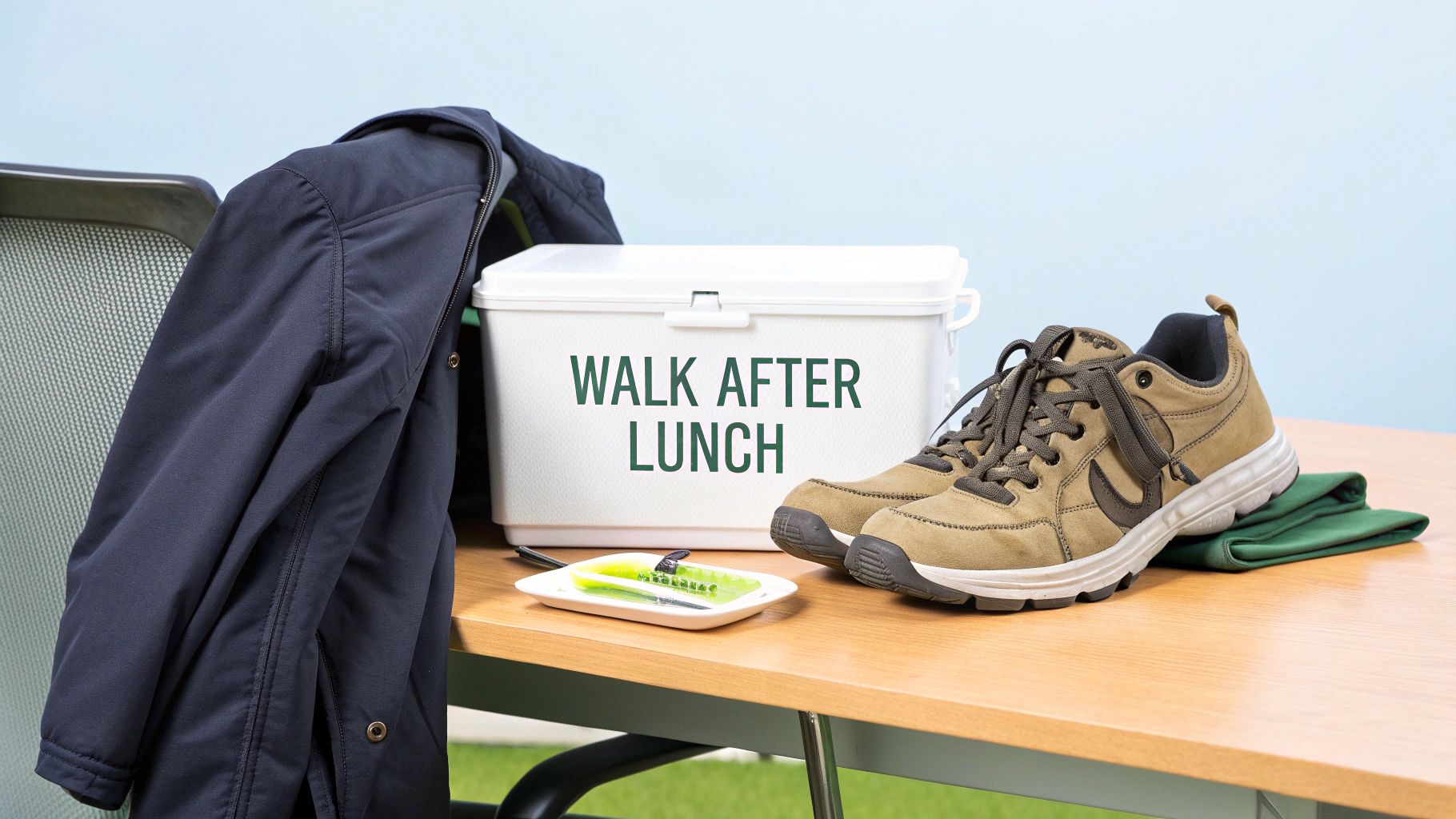
This particular stack is one of the most practical habit stacking examples for professionals and students because it directly targets a universal productivity killer: the afternoon dip. By linking movement to a meal, you transform a biological necessity into a strategic advantage, ensuring your focus remains sharp when it often starts to fade.
Strategic Breakdown
- Trigger: The act of finishing your lunch (clearing your plate, putting away your lunchbox).
- Micro-Action: A 10 to 15-minute walk, stretch, or another form of light movement.
- Timing: Immediately after your meal is finished, before returning to your desk or studies.
- Ideal For: Remote workers, office employees, and students looking to improve afternoon concentration and avoid sedentary habits.
Key Insight: This stack breaks the cycle of post-meal fatigue. The light physical activity aids digestion, increases blood flow to the brain, and provides a crucial mental context-shift away from work, which is essential to keep focus on work for longer periods.
Actionable Takeaways
To make this habit stick, your goal is to make the transition from eating to moving as seamless as possible. Reduce every point of friction that might convince you to just sit back down.
- Prepare Your Gear: Keep a comfortable pair of walking shoes and a jacket right by your desk or door. This visual cue acts as a powerful reminder and eliminates the “it’s too much effort” excuse.
- Use the “Two-Minute Rule”: If a 15-minute walk feels daunting, commit to just a two-minute walk around the block or even a few laps around the office. The act of starting is more important than the duration.
- Digital Detox Pairing: Use a Digital Detox App to schedule a “Focus Session” that starts 15 minutes after your lunch break ends. This creates a hard deadline for your walk and ensures you return to a distraction-free environment, ready to dive back into deep work.
4. Getting Dressed + Setting Daily Intention
This mindfulness-based stack pairs the automatic, daily ritual of getting dressed with the powerful cognitive practice of setting a single, clear intention for the day. While you physically prepare your body for the tasks ahead, you also mentally prepare your mind, aligning your focus on what truly matters. This turns a routine moment into a powerful act of strategic commitment.
This is one of the most effective habit stacking examples because it requires no extra time, only a shift in mindset. Instead of mindlessly choosing an outfit, you create a direct link between your physical actions and your mental priorities, ensuring you start the day with purpose before the first distraction ever arrives.
Strategic Breakdown
- Trigger: The act of opening your closet or drawer to choose your clothes for the day.
- Micro-Action: Define one specific, measurable intention (e.g., “I will complete the project proposal before lunch”).
- Timing: While you are physically getting dressed.
- Ideal For: Professionals seeking focus, students managing priorities, and anyone looking to combat reactive, chaotic days with proactive clarity.
Key Insight: This stack leverages “embodied cognition,” the idea that our physical actions influence our thoughts. The act of putting on clothes to face the world becomes a physical reinforcement of the mental state you intend to carry throughout the day.
Actionable Takeaways
To make this habit stick, you need to make your intention tangible and difficult to forget. The goal is to move from a fleeting thought to a guiding principle for your day.
- Make it Visible: Use a dry-erase marker to write your single intention on your bathroom mirror or a sticky note on your laptop. This visual reminder reinforces your commitment beyond the morning routine.
- Speak it Aloud: The act of verbalizing your intention while getting dressed adds another sensory layer, making it more concrete and memorable in your brain.
- Digital Detox Pairing: Use a Digital Detox App to set your daily intention as the lock screen wallpaper on your phone. Every time you pick up your device, you are immediately reminded of your primary goal, helping you use your phone as a tool rather than a distraction.
5. Eating Meals + Gratitude Practice
Pairing the universal habit of eating with a moment of gratitude transforms a routine biological function into a powerful mindfulness practice. This stack attaches a new, mentally beneficial habit (gratitude) to one of the most consistent and frequent anchors in your day (meals). The sensory cues of food, such as its sight, smell, and the act of sitting down to eat, become potent triggers for a moment of reflection and appreciation.
This method is one of the most profound habit stacking examples because it requires no extra time, only a shift in attention. Instead of mindlessly consuming food while distracted by a screen, you create a dedicated pause that fosters a healthier relationship with food and a more positive mental state, improving both digestion and disposition.
Strategic Breakdown
- Trigger: Sitting down to eat a meal (breakfast, lunch, or dinner).
- Micro-Action: A 30 to 60-second gratitude practice (a silent thought, spoken words, or a short journal entry).
- Timing: Immediately before taking the first bite of food.
- Ideal For: Families wanting to foster connection, individuals practicing mindful eating, and anyone looking to cultivate a more positive outlook without adding another task to their schedule.
Key Insight: This stack leverages the principle of “priming.” By initiating the meal with gratitude, you prime your brain for a more positive and mindful experience. This practice shifts your state from a reactive, often rushed, mode to a present and appreciative one, which can reduce stress-related eating and enhance the psychological benefits of your meal.
Actionable Takeaways
To implement this habit stack successfully, focus on making the gratitude practice specific and consistent. The goal is to make it an automatic part of the mealtime ritual.
- Be Specific: Instead of a generic “thanks for the food,” be specific. Mentally thank the farmer who grew the vegetables or appreciate the colors on your plate. Specificity deepens the feeling of gratitude.
- Start with One Meal: Don’t try to implement this for every meal and snack at once. Choose one meal, like dinner, to consistently practice gratitude. Once the habit is established, it will naturally expand.
- Tech-Free Table Rule: Pair this habit with a no-phones-at-the-table rule. Use a Digital Detox App to set a “Family Focus” session during mealtimes, which blocks notifications for everyone and creates an environment where mindful connection can flourish.
6. Shower + Planning Next Day
This cognitive productivity stack pairs a routine evening shower with planning the next day’s schedule, turning a mundane task into a high-leverage strategic session. The warm, isolating environment of a shower reduces external distractions and encourages diffuse-mode thinking, which is ideal for creative problem-solving and prioritizing tasks without the pressure of a screen.
This is one of the more unique habit stacking examples as it creates a sanctuary for thought. By using the automatic pilot nature of showering, you free up cognitive resources to mentally walk through your upcoming commitments, set your top three priorities, and visualize a successful day before it even begins.
Strategic Breakdown
- Trigger: The act of stepping into the shower and starting the water.
- Micro-Action: Mentally reviewing or outlining the top 3 priorities for the next day.
- Timing: During your evening shower, when your mind is relaxed and away from digital devices.
- Ideal For: Entrepreneurs, busy professionals, and anyone who feels overwhelmed by morning decision-making and wants to start their day with a clear plan.
Key Insight: This stack leverages the psychological phenomenon known as the “incubation effect.” By stepping away from a problem (your schedule) and engaging in an unrelated, low-effort task (showering), your subconscious mind can process information more effectively, leading to clearer, more insightful plans.
Actionable Takeaways
To make this stack stick, you must have a system to capture the plans you formulate. The goal is to make your ideas tangible as soon as you step out.
- Capture Your Thoughts: Keep a waterproof notepad and pencil in the shower or place a voice recorder on a nearby shelf. This removes the pressure to remember everything.
- Set the Stage: Before getting in, glance at your calendar or to-do list. This primes your brain with the necessary context without requiring you to stare at a screen.
- Immediate Transfer: The most critical step is to transfer your top priorities from your notepad or voice memo to your official planner or digital app immediately after drying off. This solidifies the plan.
7. Evening News/Social Media Check + Digital Detox
This habit stack strategically fences in a common digital habit (checking news or social media) to trigger a period of intentional disconnection. Instead of allowing a quick check to devolve into an hour of mindless scrolling, you use the act of checking itself as the starting gun for your evening digital detox, reclaiming your time and mental space before bed.
This powerful technique is one of the most practical habit stacking examples for modern life because it doesn’t demand you give up your digital connections entirely. It simply adds a crucial boundary, transforming a potentially anxiety-inducing habit into a contained, structured activity that paves the way for a restful, screen-free evening.
Strategic Breakdown
- Trigger: Opening your preferred news app or social media feed in the evening.
- Micro-Action: Activating a device-wide “Focus Session” or physically putting your phone away for a set period (e.g., 60-90 minutes before bed).
- Timing: Immediately after your final, intentional “catch-up” session for the day.
- Ideal For: Anyone struggling with nighttime “doomscrolling,” individuals seeking better sleep quality, and families wanting to establish screen-free evening rituals.
Key Insight: This stack re-engineers your evening routine. Instead of social media being the end of your day, it becomes a transitional event. The brain learns to associate the closing of the app not with a sense of loss, but with the beginning of a rewarding, low-stimulation activity like reading, conversation, or journaling.
Actionable Takeaways
Success here depends on creating a hard stop that is easy to enforce. The goal is to make disconnecting more automatic than continuing to scroll.
- Set a Hard Time Limit: Use a physical kitchen timer or your phone’s built-in timer for a 15-minute social media or news window. When the alarm sounds, the session is over, no exceptions.
- Create Physical Distance: After your time is up, immediately place your phone in another room to charge overnight. Removing the visual and physical temptation is critical for breaking the habit loop.
- Use an App Blocker: For a more robust approach, use a Digital Detox App to schedule a “Focus Session” that automatically blocks distracting apps after a certain time, like 9 PM. If you’re new to the concept, you can learn how to do a digital detox with a structured plan.
8. Arriving Home + Changing Clothes/Mental Transition
Pairing the act of arriving home with immediately changing your clothes creates a powerful psychological boundary between your work and personal life. This habit stack uses a simple, physical action as a definitive trigger to signal a mental shift, helping you leave the day’s stress at the door and transition into a more present, relaxed state for the evening.
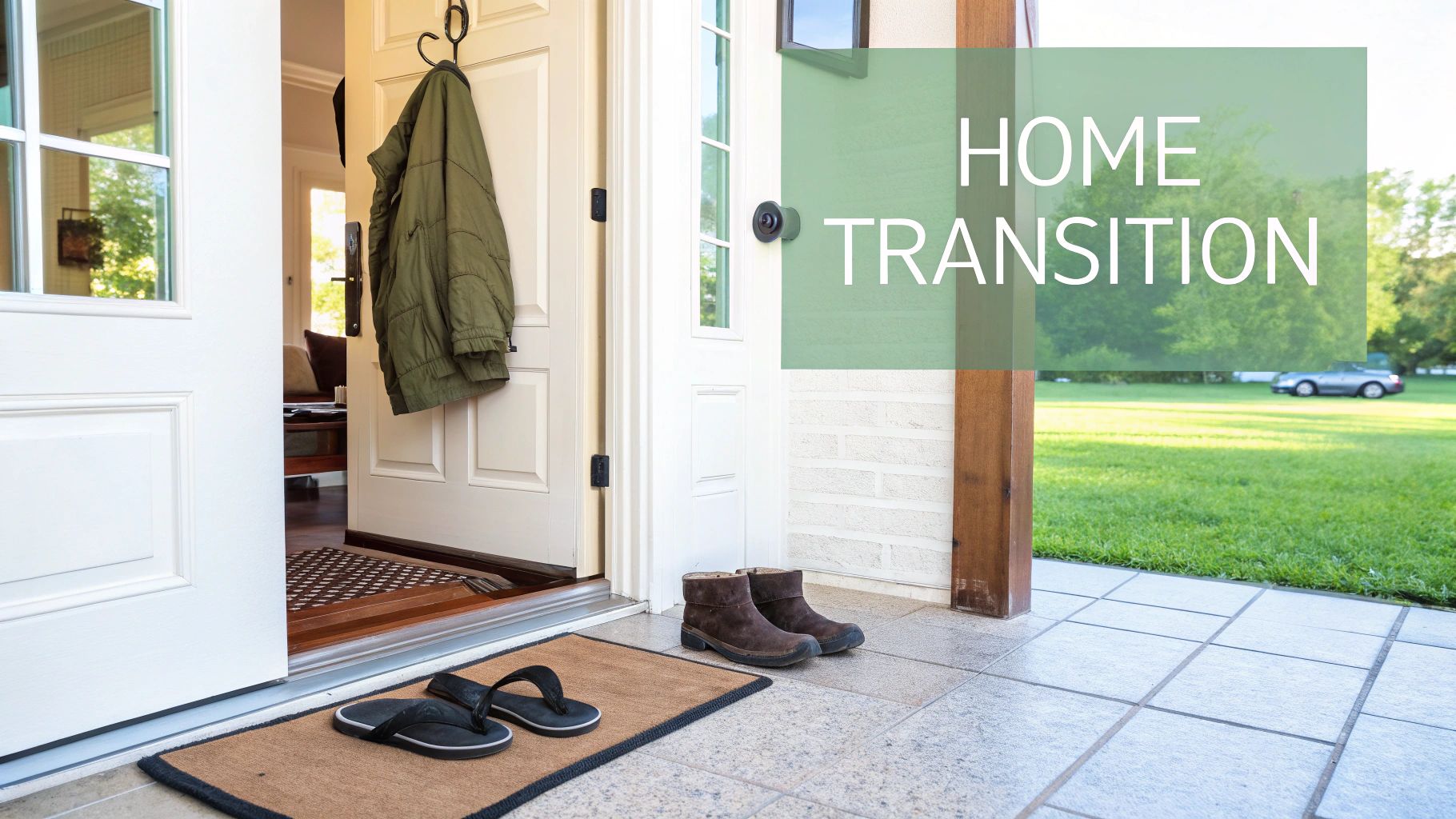
This is one of the most impactful habit stacking examples for improving work-life balance, especially for remote workers whose physical environment doesn’t change. The clothing change acts as a “state change” ritual, breaking the mental continuity of the workday and preventing professional concerns from bleeding into personal time.
Strategic Breakdown
- Trigger: Walking through the front door after work.
- Micro-Action: Changing out of “work clothes” and into “home clothes.”
- Timing: Immediately upon arrival, before getting settled or distracted by other tasks.
- Ideal For: Remote workers, busy professionals, parents, and anyone struggling to mentally “switch off” after a demanding day.
Key Insight: This stack leverages “enclothed cognition,” the idea that the clothes we wear influence our thoughts and behaviors. By associating specific outfits with relaxation and personal time, you are physically and mentally cueing your brain that the workday is officially over, making the transition concrete and not just an abstract intention.
Actionable Takeaways
To make this transition ritual seamless and effective, you need to reduce any friction that might get in the way of the habit.
- Prepare Your “Home” Outfit: Lay out your comfortable clothes in an obvious place near the entrance or in your bedroom. The visual cue reminds you of the habit the moment you walk in.
- Use the “Two-Minute Rule”: If a full change feels like too much initially, start small. Stack your arrival with just kicking off your work shoes and putting on slippers. The goal is to establish the physical act of transition first.
- Digital Detox Pairing: Activate a “Wind Down” Focus Session on your Digital Detox App as you change. This can automatically switch your phone to a limited-app mode, block work notifications, and play a calming playlist, reinforcing the mental shift away from work.
8 Habit-Stacking Examples Comparison
| Habit | 🔄 Implementation Complexity | ⚡ Resource Requirements | 📊 Expected Outcomes (⭐) | Ideal Use Cases | 💡 Key Advantages |
|---|---|---|---|---|---|
| Morning Coffee + Meditation | Low — simple cue-response pairing 🔄 | Minimal — coffee routine + optional app ⚡ | Improves focus and lowers morning stress — ⭐⭐⭐ | Busy mornings, remote workers, corporate wellness | Leverages strong existing habit; easy to remember |
| Brushing Teeth + Flossing | Very Low — same-location sequence 🔄 | Minimal — floss or water flosser ⚡ | Better oral health and higher floss compliance — ⭐⭐⭐ | Universal use, families, dental recommendations | High adherence; negligible extra time |
| After Lunch + Walk/Movement Break | Low–Medium — requires scheduling 🔄 | Low — shoes/space and 10–15 min ⚡ | Reduces post-lunch fatigue; boosts productivity & cardio health — ⭐⭐⭐ | Offices, remote workers, students | Counters energy dip; improves mood & creativity |
| Getting Dressed + Setting Daily Intention | Low — integrates with routine dressing 🔄 | Minimal — mental focus, optional mirror note ⚡ | Greater purpose and prioritization (variable) — ⭐⭐ | Professionals, athletes, anyone needing direction | Combines physical prep with goal-setting; minimal time cost |
| Eating Meals + Gratitude Practice | Low — recurring trigger (meals) 🔄 | Minimal — verbal or short reflection ⚡ | Increased mindfulness, satisfaction; may reduce overeating — ⭐⭐⭐ | Families, schools, mindful-eating programs | Repeated practice (3x/day); culturally adaptable |
| Shower + Planning Next Day | Low–Medium — requires habit of reflection 🔄 | Low — waterproof notepad or voice memo ⚡ | Better organization; reduced decision fatigue — ⭐⭐⭐ | Busy professionals, students, parents | Uses passive time productively; enhances preparedness |
| Evening News/Social Media Check + Digital Detox | Medium — needs discipline/tools 🔄 | Low–Moderate — timers/app blockers ⚡ | Improved sleep and reduced digital anxiety — ⭐⭐⭐ | Families, people prone to late-night scrolling | Creates clear boundaries; limits blue-light exposure |
| Arriving Home + Changing Clothes/Mental Transition | Low — physical cue for psychological shift 🔄 | Minimal — spare “home” clothes ⚡ | Stronger work–life separation; reduced burnout — ⭐⭐⭐ | Remote workers, parents, executives | Simple, observable ritual that signals transition |
From Theory to Action: Designing Your Own Habit Stacks
Throughout this guide, we’ve explored a variety of practical habit stacking examples, from pairing your morning coffee with meditation to using your evening screen time as a trigger for a digital detox. The underlying principle is elegantly simple yet profoundly effective: lasting change is not born from monumental effort, but from the consistent linking of small, intentional actions to the established rhythms of your daily life. The power isn’t in the new habit alone; it’s in the neurochemical bridge you build from an existing, automatic behavior.
The key takeaway is that your current routine is already a powerful foundation waiting to be built upon. You don’t need to reinvent your entire day. Instead, you can leverage the momentum of what you already do consistently, whether it’s brushing your teeth, finishing lunch, or arriving home from work. This strategic pairing lowers the barrier to entry for new behaviors, making them feel less like a chore and more like a natural extension of your day.
Your Blueprint for Building a Personal Habit Stack
Ready to move from inspiration to implementation? Here is a replicable, step-by-step framework to architect your own habit stacks for maximum impact:
Identify Your Anchor Habit: Start by listing the things you do every single day without fail. These are your “anchor” habits. Choose one that is reliable, consistent, and has a clear beginning and end. A vague anchor like “when I have free time” is doomed to fail; a specific one like “after I set my coffee mug on my desk” is built to succeed.
Select a Micro-Habit: Your new desired habit should be incredibly small, ideally taking less than two minutes to complete. The goal is to make it so easy you can’t say no. Instead of “read more,” start with “read one page of a book.” Instead of “get fit,” start with “do five push-ups.”
Craft Your Stacking Formula: Combine your anchor and your micro-habit using the simple formula: “After I [Current Habit], I will [New Habit].” Write it down and say it aloud. This solidifies the connection in your mind. For example: “After I put my dinner plate in the dishwasher, I will set out my workout clothes for tomorrow.”
Visualize and Track Your Progress: Consistency is the engine of habit formation. To effectively monitor your progress and solidify new behaviors, consider using a daily habit tracker printable. Visibly tracking your streak provides motivation and valuable feedback on what’s working.
By following this strategic blueprint, you transform the abstract concept of self-improvement into a concrete, actionable process. You are no longer just hoping for change; you are engineering it, one small, intelligent link at a time. This approach empowers you to reclaim your focus, enhance your well-being, and build a life aligned with your deepest intentions.
Ready to build the ultimate habit stack for digital wellness? The Digital Detox App Hub is designed to be the perfect “new habit” to stack onto your existing routines, helping you create firm boundaries with technology. Start your journey toward a more focused and present life today by trying the Digital Detox App.