How to Quit Social Media for Good: An Actionable Guide
Quitting social media isn’t about winning a battle of willpower; it’s about executing a smart, personal strategy. The simplest framework boils down to this: figure out your ‘why,’ pick a method that fits your life, like going cold turkey or a gradual fade, and do some prep work by managing expectations and saving your data. This approach turns a daunting challenge into an empowering, controlled choice.
Why It’s So Hard to Quit Social Media
If you feel trapped by social media, let me be clear: this is not a personal failure. These apps are designed to be addictive, using finely tuned psychological hooks that keep you scrolling long after the fun stops. Understanding this dynamic is the first real step toward breaking free, as it shifts the blame from you to the system you’re trying to escape.

At the heart of it all is the concept of variable rewards. It’s the same principle that makes a slot machine so compelling. You never know if the next refresh will bring a flood of likes, an exciting message, or absolutely nothing. This unpredictability creates a powerful, dopamine-fueled compulsion to check again and again, wiring the habit deep into your brain.
The Psychology Behind the Scroll
This constant cycle of checking and rewarding fuels a powerful fear of missing out (FOMO). Every moment you’re not logged in can feel like a missed opportunity for connection, validation, or some critical piece of news. The platforms are literally engineered to make you feel that logging off means becoming invisible. The implication is clear: the system is built to equate your absence with irrelevance, a powerful motivator to stay plugged in.
The scale of this problem is staggering. Projections show that by 2025, around 210 million people worldwide could be suffering from social media addiction. In the U.S. alone, a shocking 40% of young adults aged 18-22 admit they are addicted. It’s not surprising when teens are spending an average of 4.8 hours a day on these platforms—a habit increasingly linked to a rise in mental health issues. If you want to dig into the numbers, this comprehensive look at social media addiction statistics is a real eye-opener.
Quitting social media isn’t just about deleting an app. It’s about dismantling a deeply ingrained habit system that was intentionally built to keep you hooked.
Creating Your Personal Quitting Framework
Instead of seeing this as an impossible fight, reframe it as a strategic retreat. A successful exit doesn’t hinge on superhuman willpower; it depends on a clear, personalized plan. This guide provides a practical framework, not rigid rules, so you can disconnect on your own terms.
To give you a better sense of the journey ahead, here’s a quick overview of the core phases.
Your Quitting Blueprint at a Glance
This table breaks down the essential phases for a successful social media detox. Think of it as your strategic map, helping you see the whole picture from the start.
| Phase | Key Action | Why It Matters: The Insight |
|---|---|---|
| 1. The ‘Why’ Phase | Define specific, personal reasons for quitting. | Your ‘why’ is your anchor. It’s the rational defense against the emotional pull of FOMO and boredom. A vague goal won’t hold up. |
| 2. The Strategy Phase | Choose your approach: cold turkey vs. gradual fade. | This decision aligns the method with your personality. Choosing the wrong one sets you up for failure by creating unnecessary friction. |
| 3. The Preparation Phase | Save data, notify key people, and line up alternatives. | This phase is about removing barriers to success. Good preparation prevents panic and eliminates excuses to log back in. |
By breaking it down like this, you can see that the process is manageable and strategic, not just a test of endurance.
Your journey really starts with three foundational steps that we’ll dive into next:
- Define Your ‘Why’: What do you hope to gain? More focus? Better sleep? Deeper real-world connections? Get specific. This reason will be your north star.
- Choose Your Quitting Style: Not everyone succeeds with the same method. You might need a clean break (cold turkey), or you might do better with a more measured, gradual fade. We’ll explore which is right for you.
- Prepare for Success: A little groundwork goes a long way. Notifying friends and saving your data prevents logistical headaches and lets you focus on the detox itself.
By focusing on these practical steps, you shift from feeling controlled by the algorithm to taking back the reins of your digital life.
Your Pre-Quitting Digital Checklist
Jumping into a social media detox without prep is like moving house without packing—chaotic, stressful, and you’re bound to lose something important. A few strategic moves beforehand can transform your experience from a frantic escape into a smooth, intentional transition. This isn’t about creating more work; it’s about setting yourself up for a successful, regret-free break.
Conduct a Personal Social Media Audit
Before hitting “deactivate,” understand what you’re up against. A personal audit is about honestly observing your own behavior to see exactly how and why you use these platforms. For a few days, just pay attention. Don’t judge, just notice. Ask yourself these key questions:
- When do I scroll the most? Is it first thing in the morning, late at night, or during lulls at work?
- What triggers me to open the app? Is it a notification? A feeling of loneliness? Pure muscle memory?
- How do I feel after using it? Energized and connected, or anxious, drained, and maybe a little envious?
This audit provides a crucial insight: you’re likely not quitting an app, but a coping mechanism for uncomfortable emotions. Acknowledging this helps you anticipate the challenges ahead.
Notify Key People and Preserve Connections
A sudden digital disappearance can worry friends and family. A common mistake is going silent, which can inadvertently cause concern. You don’t need a dramatic announcement, but a little communication goes a long way.
Consider sending a simple text or email to your closest contacts. Let them know you’re taking a break from social platforms to focus on other things and tell them the best way to reach you, like by phone or email. This manages expectations and reinforces your real-world connections—which are crucial for mitigating the loneliness that can sometimes pop up during a detox.
Don’t let your digital exit damage your real-world relationships. A quick message ensures the people who matter know how to find you, turning your detox into a chance to deepen offline bonds.
Secure Your Digital Assets
Your social media accounts have become digital scrapbooks, address books, and even login keys. Losing access to that data is a major source of post-quitting regret. Before you disconnect, download your history.
Most platforms like Facebook and Instagram have a built-in feature to download a complete archive of your data. This file typically contains:
- Your photos and videos: All those shared memories.
- Contact information: Friends’ birthdays, phone numbers, and other details.
- Messages and conversations: Important chats you might want to reference later.
Think of this as your insurance policy. You get to keep the memories without being tethered to the platform. It’s about preserving your past while reclaiming your future.
Finally, do a quick inventory of any apps or services where you use a social media account to log in. Think about services like Spotify, DoorDash, or news sites. Disconnecting your primary social account without updating these logins could lock you out. Go into the settings of each third-party app and switch your login method to an email and password to avoid frustrating logistical headaches.
Choosing Your Quitting Strategy
You’ve done the prep work and you’re ready to make the leap. Now comes the big question: how are you actually going to do this? There’s no one-size-fits-all answer. The best way to quit is the way that actually sticks, and that depends entirely on your personality. The two main paths are the “cold turkey” approach and the “gradual fade.” One is a clean break; the other is a structured transition. Your choice here is critical, as it will shape your experience in the first few weeks.
The Cold Turkey Approach: A Clean Break
Going cold turkey is exactly what it sounds like: you log out, deactivate, or delete all your accounts at once. It’s a bold, immediate move that slams the door shut on old habits. This method works wonders for people who know that leaving even a sliver of access is a recipe for falling back into the endless scroll.
The biggest benefit is the finality. There’s no gray area. You’re not wrestling with yourself about when or how much to check in, because the option is gone. This forces you to immediately find new ways to fill your time.
However, the initial shock can be intense. The primary implication of this method is a period of withdrawal. While quitting ultimately reduces stress, pulling the plug so abruptly can crank up feelings of loneliness. Getting through that first week is the single biggest challenge of going cold turkey.
Actionable insights to make it work:
- Front-load your social life: Plan coffee dates, phone calls, and actual activities for those first few days to combat loneliness.
- Have a replacement action ready: Your thumb will instinctively go to where the app used to be. When it does, have a plan: open a book app, a news site, or your notes app instead.
- Keep your “why” front and center: Remember your reasons for quitting. That clarity is your best defense when discomfort kicks in.
No matter which path you take, a little prep work goes a long way. This flowchart hits the key actions you should take before you pull the trigger.
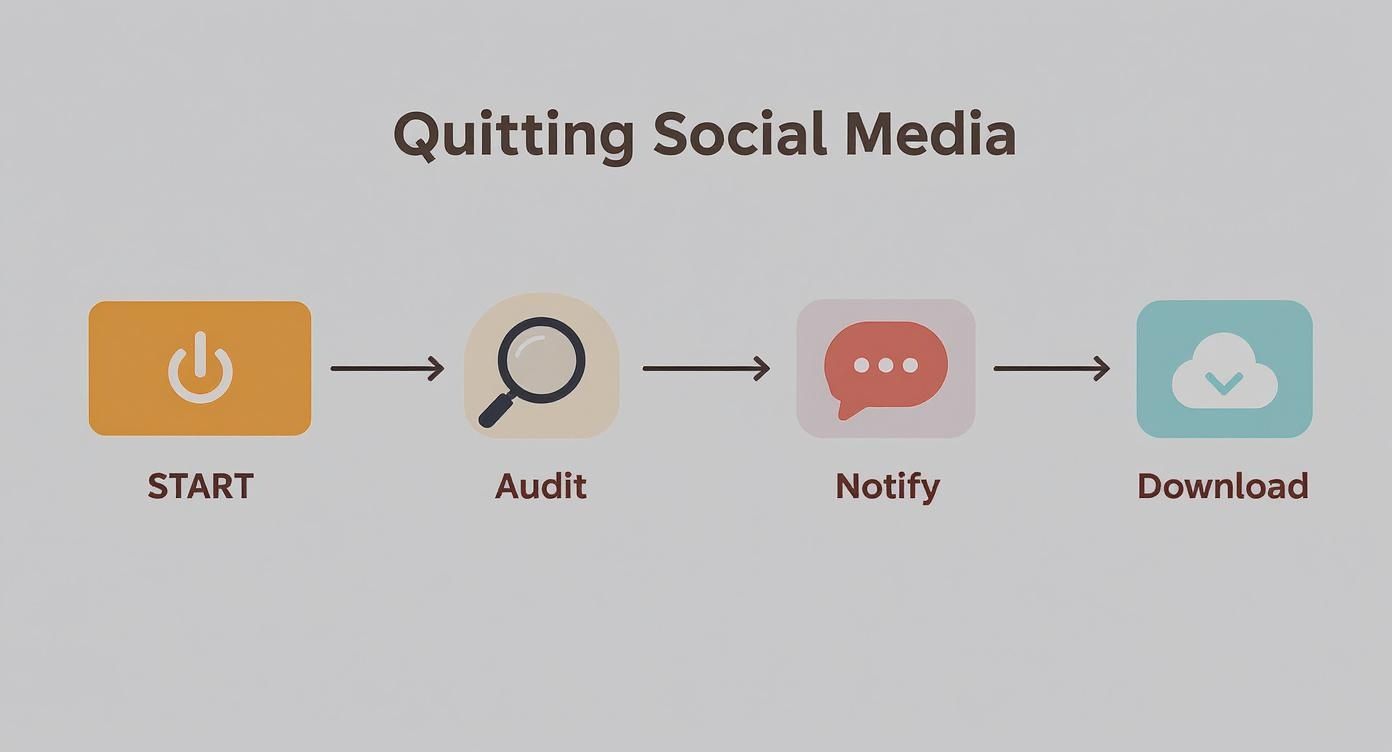
Starting with a clear goal, auditing your use, telling people your plan, and downloading your data—these are the building blocks for a break that actually lasts.
The Gradual Fade: A Measured Retreat
If ripping off the Band-Aid sounds too intense, the gradual fade might be your speed. This strategy is about slowly winding down your use over a set period until you hit your goal—whether that’s minimal use or a full deletion.
The key insight here is that the gradual fade demands more structured discipline than cold turkey. You’re not just flipping a switch; you’re methodically retraining your brain. For many, this feels far more sustainable and less like a shock to the system.
A solid, actionable plan might look like this:
- Week 1: Set App Timers. Use your phone’s wellness settings to cap your time on each app at 30 minutes a day. When the timer’s up, you’re done. No exceptions.
- Week 2: Delete the Apps, Not the Account. This is a game-changer. By removing the apps, you have to log in through a clunky mobile browser. That extra friction kills mindless, muscle-memory checking.
- Week 3: Schedule Your Check-ins. Pick one or two specific 15-minute slots per day to check social media from a computer. Outside of those windows, it’s off-limits.
- Week 4: Deactivate. You’ve proven you can stick to a tight schedule. Now take the final step and pull the plug on the accounts.
If you thrive on structure, following a program like the 7-day digital detox challenge can provide the framework and support to make a gradual fade successful.
Cold Turkey vs. Gradual Fade: A Key Comparison
So, how do you choose? It comes down to self-awareness. Are you an all-or-nothing person, or do you do better with small, steady changes? This table offers a direct comparison to help you decide.
| Factor | Cold Turkey Approach | Gradual Fade Approach |
|---|---|---|
| Initial Difficulty | High. The first week can feel like withdrawal, with a real potential for loneliness. | Low to Moderate. The transition is smoother, reducing the initial shock. |
| Simplicity | Very Simple. The rule is absolute: no social media. No negotiation. | More Complex. Requires setting and sticking to specific rules, timers, and schedules. |
| Risk of Relapse | Higher in the first few days, but drops off significantly if you can push through that phase. | Lower at first, but continued access can be a constant temptation to bend your own rules. |
| Best For | People who prefer a clean slate and find that trying to moderate just doesn’t work for them. | Those who need to adjust slowly or have work/social ties that make a sudden exit impossible. |
Ultimately, there isn’t a “better” strategy—only the one that’s going to work for you. The goal is the same: to get your time and attention back.
The Practical Steps to Disconnect
Talking about quitting is one thing. Actually pulling the plug is another. Success isn’t about one grand gesture; it’s about layering small, intentional acts of friction that make it easier to stay offline than to fall back into old habits.
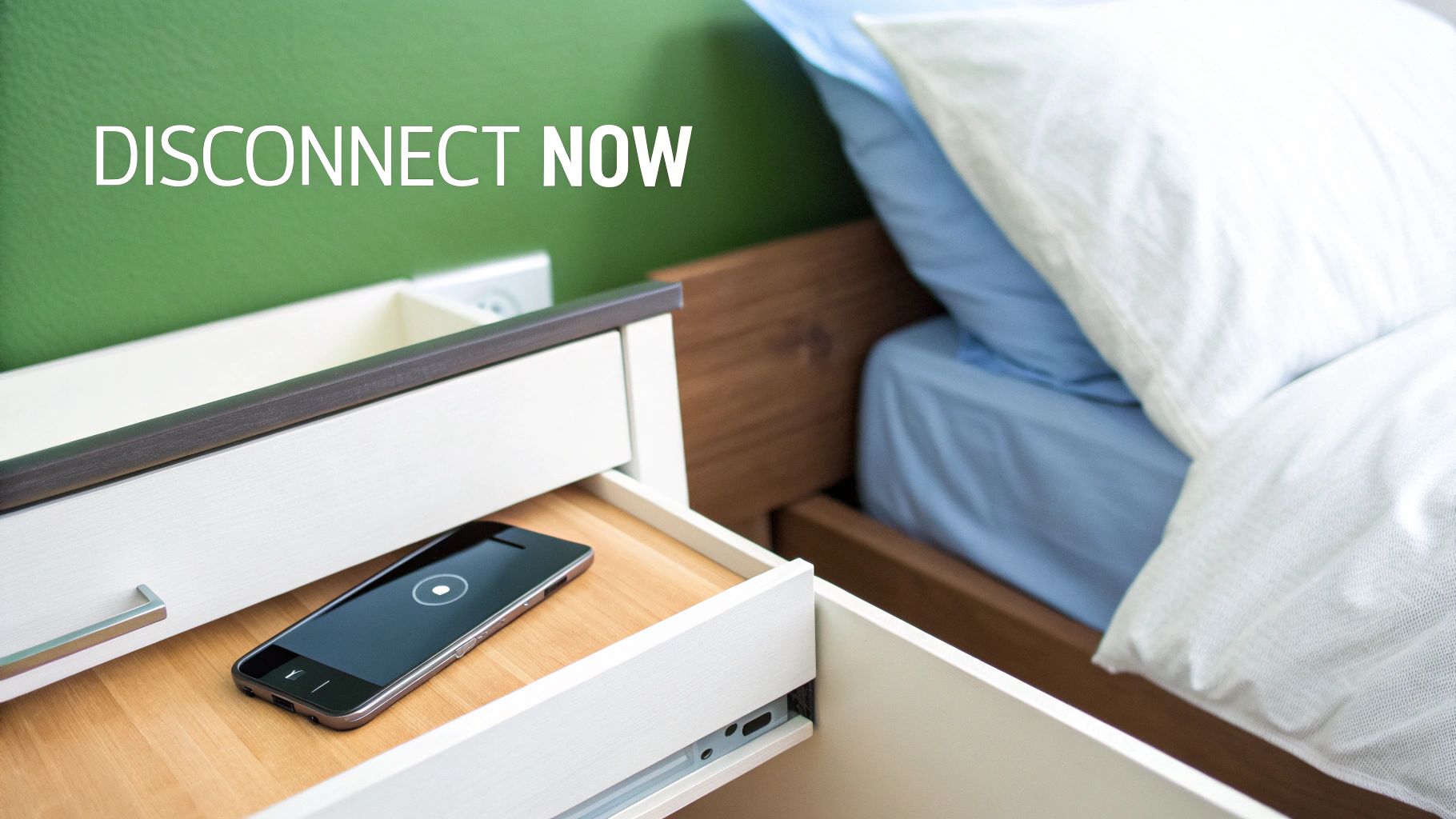
We’re going to build a fortress around your attention, using both technical barriers and simple shifts in your daily life to counter the powerful, engineered pull of these platforms.
Creating Technological Barriers
Your first line of defense is using technology against itself. The mission: make getting onto social media a pain. Every extra click is another moment to pause and ask if mindless scrolling is really what you want to be doing.
Start with the knockout punch: delete the apps from your phone. This single action removes the main gateway for compulsive checking. When the icon isn’t there, that muscle-memory tap has nowhere to go.
Next, fortify your other devices:
- Install Website Blockers: Use browser extensions like Freedom or Cold Turkey to block social media sites on your computer. Set schedules or block them for good.
- Unsubscribe from All Emails: Platforms will try to lure you back with “You have new notifications!” emails. Before you deactivate, dive into your account settings and turn off every single email notification.
- Log Out Everywhere: Make sure you are logged out on every browser and device you own. Having to re-enter a password is a surprisingly effective deterrent.
Re-Engineering Your Physical Environment
The way you set up your physical space has a massive impact on your digital habits. The insight here is to create an environment that makes disconnecting the easy choice.
Compulsive checking is a hallmark of social media addiction, with about 50% of users checking their accounts hourly. A staggering 79% of smartphone users keep their devices within reach 24/7. To fight this, you need to make your phone less accessible.
Your environment should make the right choice the easy choice. If your phone is out of sight, it’s much more likely to be out of mind.
One of the most powerful moves is to buy an old-school alarm clock and move your phone charger out of the bedroom. This single act shatters the habit of late-night and first-thing-in-the-morning scrolling.
Another surprisingly effective tactic? Switch your phone screen to grayscale. Without vibrant, stimulating colors, the digital world loses its allure. The endless scroll suddenly feels more like a chore than a reward. For more practical ideas, check out our guide on proven ways to reduce screen time.
Deactivating vs Deleting Your Accounts
Now for the main event: deciding the fate of your accounts. You have two options—deactivation or deletion—and the right one depends on your level of commitment.
- Deactivation: This is like putting your account into hibernation. Your profile and data are saved, but your profile becomes invisible. It’s a fantastic, low-risk way to test the waters of a social media-free life. The implication is that you can always return, which can be both a safety net and a temptation.
- Deletion: This is the permanent, irreversible option. After a grace period (usually about 30 days), all your data is gone for good. If you know deep down that moderation won’t work for you, this clean break is often the best choice.
As you go through this process, it’s also the perfect time to start setting healthy boundaries for your digital life. This helps solidify your new habits and prevents you from slipping back into old patterns.
Building a Fulfilling Life Offline
Quitting social media isn’t just about what you’re giving up; it’s about what you’re making room for. The process frees up a shocking amount of time and mental space—for the average user, that’s over two hours every single day. At first, this new void can feel uncomfortable. But that feeling is temporary, and what comes next is the single greatest benefit of your entire detox.

This is your chance to intentionally build a richer, more engaging life offline. The goal is to create a life so compelling that the thought of going back to endless scrolling feels like a massive downgrade.
Rediscovering Your Analog Self
Think back to life before social media. What did you do for fun? What hobbies got pushed aside because you “never had the time”? Now you do. This is the perfect moment to dust off those old passions. Don’t try to become a concert pianist overnight. Start small with things that bring you actual joy.
- Get Your Hands Dirty: Try something tactile like gardening, baking, or learning a guitar. Activities that keep your hands busy are fantastic for keeping them off your phone.
- Challenge Your Brain: Start a reading challenge, tackle a complex puzzle, or try learning a new language.
- Explore Your Own Backyard: Make a list of local parks, museums, or cafes you’ve always meant to visit. Plan to check one off the list each weekend.
By filling your time with intention, you’re replacing passive consumption with active, fulfilling participation in your own life. You can dive deeper into all the positive outcomes by exploring the many social media detox benefits.
Deepening Real-World Connections
Quitting social media can feel lonely at first, but it’s a powerful opportunity to strengthen the relationships that actually matter. You have to be proactive. It’s time to shift from low-effort online interactions to deliberate, meaningful engagement.
The cure for loneliness isn’t a crowded newsfeed; it’s authentic connection. Quitting social media forces you to invest in the relationships that truly matter, replacing digital noise with genuine presence.
For instance, the next time you feel the urge to see what friends are up to online, use that impulse to actually call one of them. See a local event that looks cool? Text a friend and make real plans. This table breaks down the difference in the dynamic.
| Online Socializing | Offline Socializing |
|---|---|
| Passive & Performative | Active & Authentic |
| Low-effort interactions (likes, comments) | Requires scheduling and presence |
| Based on curated highlight reels | Involves real, unfiltered conversation |
| Often fuels comparison and anxiety | Builds genuine empathy and support |
Navigating Boredom and Loneliness
It’s completely normal to feel bored or lonely in the early days. These feelings aren’t a sign of failure; they’re a signal that your brain is recalibrating after years of non-stop digital stimulation. Instead of seeing boredom as a problem that needs a screen to solve it, try seeing it as an invitation to just be.
When boredom hits, resist the knee-jerk reaction to grab your phone. Sit with the feeling for a few minutes. This is often when our best ideas show up. Loneliness, too, is a valuable cue, nudging you to make those meaningful connections we just talked about.
Ultimately, quitting social media is about embracing a more intentional way of living. For a wider lens on this journey, it’s worth reading up on how to truly get a life. The point is to start looking inward for fulfillment instead of outward for validation.
What About the “What Ifs”?
Deciding to quit social media is a huge step. But right after that decision, a whole new set of “what ifs” usually floods in. These nagging questions are completely normal—they’re often the final hurdles between you and a more intentional, focused life.
Let’s tackle the most common ones head-on so you can move forward with confidence.
What If My Job Requires Social Media?
This is probably the biggest and most valid concern out there. For a lot of us, social media isn’t just for cat videos; it’s a professional tool. The key here isn’t to blow up your career, but to build rock-solid boundaries between professional use and personal consumption.
Start by taking a hard look at what your job truly requires versus what has simply become a habit. You might be surprised to find that many of those “required” tasks aren’t as critical as they feel.
Here’s a practical battle plan:
- Create a Work-Only Profile: If you can, use a separate device or a dedicated browser profile just for work-related social media. This creates a psychological and digital wall, stopping work duties from creeping into your personal time.
- Install a Newsfeed Blocker: Tools like a newsfeed eradicator are a game-changer. They let you post, message, and manage pages without getting sucked into the endless, soul-crushing scroll of the main feed.
- Time-Block Your Usage: Be surgical. Schedule specific, short blocks of time for these tasks—say, 15 minutes at 10 AM and 15 minutes at 3 PM. Log in, do what you need to do, and get out.
You can even frame this new approach to your boss as a productivity hack. By killing the distractions, you’re focusing your energy on high-value work. It’s a win-win.
How Do I Handle the Fear of Missing Out (FOMO)?
FOMO is a powerful, gut-level feeling. That’s not an accident; it’s by design. The first step is to simply acknowledge it without judgment. Then, immediately reframe it.
Remind yourself that what you’re seeing on social media is a highlight reel—a highly curated, often unrealistic version of someone else’s life, not the messy, beautiful, full story.
The most effective antidote to FOMO is to actively cultivate JOMO: the Joy of Missing Out. This is about finding real, genuine satisfaction in your own offline life. When that familiar anxiety hits, use it as a trigger.
Don’t fight FOMO; replace it. Every pang of anxiety is a signal to invest in a real-world activity that brings you genuine joy, turning a moment of perceived lack into an opportunity for authentic fulfillment.
Instead of scrolling to see what others are up to, call a friend and make actual plans. Go back to your personal “why” for quitting in the first place. Was it for better focus? Deeper connections? Your mental health? Keeping that motivation front and center is your best defense.
You can also ask a couple of close friends to keep you in the loop on genuinely important news. This ensures you won’t miss what truly matters while filtering out all the noise.
Should I Deactivate or Permanently Delete My Accounts?
This one really comes down to your personality and your end goal. There’s no single right answer, just what’s right for you. Think of it as choosing between a trial separation and a clean break.
Deactivation is a fantastic, low-stakes trial run. It makes your profile invisible but saves all your data—photos, contacts, messages. If you’re feeling hesitant, this is the perfect option. It lets you experience life offline while leaving the door open to come back if you decide it’s not for you.
Permanent deletion, on the other hand, is a powerful, definitive move. For those of us who know we’re prone to relapse, this clean break is often the only way. After a grace period (usually around 30 days), your data is gone forever. The temptation is completely removed.
A strategy I’ve seen work really well is to start with a 30-day deactivation. Treat it like an experiment. By the end of that month, you’ll have a much clearer perspective and the real-world experience you need to decide if taking that final step of permanent deletion is the right call.
Ready to build a healthier relationship with technology but not sure where to start? The Digital Detox App Hub offers a suite of free, simple tools designed to help you reclaim your time and focus. Whether you need a plan for a weekend detox or help setting mindful boundaries, we have a tool that does one thing well to make a real difference. Find the right app for you and begin your journey to digital balance today.