How to Keep Focus on Work and Master Your Attention
Knowing how to keep focus on work isn’t about brute-force willpower. It’s about building a smart system that shields your attention from the relentless demands of the modern workplace. The real solution lies in taking control of your environment, adding structure to your time, and training your mind to resist the constant pull of interruptions.
Why Staying Focused at Work Feels Impossible
Let’s be honest: the modern workday is a battlefield for your attention. Between the non-stop pings, back-to-back meetings, and the endless lure of the internet, deep focus can feel like a myth. If you feel like you’re losing this battle, you aren’t alone. The system is often rigged against concentration from the start.
The short answer to regaining control? Understanding that the default settings of most jobs actively sabotage focus. Your struggle is a perfectly normal response to an environment saturated with disruptions.

The Constant Barrage of Digital Interruptions
One of the biggest hurdles we face today is the sheer volume of digital noise. Research shows that employees are interrupted roughly every two minutes by meetings, emails, or chat notifications. That adds up to a staggering 275 interruptions per person, per day.
Since it takes an average of 23 minutes to fully get back on track after being distracted, most of the workday is spent in a state of partial attention. This constant context-switching creates what scientists call “attention residue,” where thoughts about the last thing you were doing linger and mess with your concentration on the current task. It’s why you feel so scattered, even when you’re trying your best.
The core problem is simple: your brain is built for single-tasking, but your work environment demands constant multitasking. This fundamental mismatch is the real reason sustained focus feels so out of reach.
Building a Framework for Deep Work
Fighting back requires a deliberate, structured game plan. This guide breaks down a practical framework built on three essential pillars, giving you a clear path to reclaiming your focus.
The table below provides a quick overview of the core strategies we’ll be diving into.
The Three Pillars of Workplace Focus
| Pillar | Core Problem | Key Solution | Key Benefit & Implication |
|---|---|---|---|
| Environment Control | Constant digital and physical distractions that pull you out of the zone. | Proactively shaping your workspace to minimize interruptions before they happen. | Benefit: Reduces decision fatigue. Implication: By removing external triggers, you conserve willpower for the actual work. |
| Time Structuring | Unprotected time that gets filled with meetings and reactive tasks. | Using proven methods like time-blocking to create dedicated windows for deep work. | Benefit: Protects your most productive hours. Implication: You shift from a reactive to a proactive workflow, dictating your own priorities. |
| Mental Training | A mind conditioned to seek novelty and switch tasks frequently. | Building mental habits and routines that strengthen your focus muscle over time. | Benefit: Increases resilience to distractions. Implication: Focus becomes a reliable skill you can deploy on demand, not a fleeting state. |
By mastering these three areas, you can build a powerful system for deep, meaningful work.
If you constantly feel like you’re swimming against a tide of distractions, exploring comprehensive strategies on how to improve focus at work without burning out can offer vital guidance. The following sections will give you the actionable steps you need to put this framework into practice, starting today.
Designing Your Workspace for Peak Concentration
Your environment is either your greatest ally or your biggest foe in the fight for focus. It’s easy to blame a wandering mind on a lack of willpower, but the truth is, our surroundings constantly pull at our attention. Architecting a workspace that actively defends that attention goes far beyond simply tidying up.
It’s about consciously designing both your physical and digital worlds to signal to your brain that it’s time for deep work.
The power of a controlled environment isn’t just a feeling—it has a real impact. Research shows remote-only employees report gaining about 29 minutes of productive time per day compared to their in-office peers. Why? A huge part of it is having more control over their immediate environment, letting them slash the in-person disruptions that shatter concentration. You can dive deeper into these workplace productivity findings in Eptura’s insightful report.
This principle of control is the key, no matter where your desk is located.
Taming Your Physical Environment
Your physical space sends constant cues to your brain. A cluttered desk filled with unrelated trinkets, old coffee mugs, and piles of paper creates visual noise, pulling your attention in a dozen different directions before you’ve even started.
The goal is to create a “focus bubble” where only the essentials for your current task are visible.
A minimalist approach works wonders here. Try clearing your desk of everything except your computer, a notebook, and a pen. It might feel strange at first, but the lack of visual distraction is calming. If you’re in a noisy open office, a good pair of noise-canceling headphones are non-negotiable. They act as a clear “do not disturb” sign to both your colleagues and your own easily distracted mind.
Think of your desk as a cockpit for productivity. A pilot has every tool within reach, clearly labeled, and free of anything non-essential. Your workspace should function with the same kind of stripped-down intentionality.
This setup does more than just look clean; it reduces decision fatigue and removes the temptation to procrastinate with “small” tasks that just happen to be in your line of sight.
Architecting Your Digital Workspace
Just as physical clutter distracts, digital chaos is equally damaging. And let’s be honest, your computer’s desktop—with its sea of icons and endless notifications—is often the primary culprit.
It’s time to create a clean slate.
- Tame Your Desktop: Drag every single file into one folder. Seriously. A clean desktop background eliminates that low-grade visual anxiety and stops you from clicking on random documents out of habit.
- Master Your Browser: This one’s a game-changer. Use a dedicated browser window for your main task with only the necessary tabs open. Got the urge to check Twitter or look up a recipe? Open a completely separate window for that. This creates a clear mental boundary.
- Silence the Pings: Turn off all non-essential notifications. This is where the Digital Detox App becomes your secret weapon. You can create focused work sessions that automatically block notifications from the apps you choose, building an impenetrable digital fortress around your attention.
These small adjustments reclaim your digital environment from a source of constant interruption and turn it back into a tool for deep work. By cleaning up your digital space, you create an environment where the path of least resistance leads directly to the task at hand.
Structuring Your Day for Uninterrupted Workflows
Time management isn’t just about what you do; it’s about when and how you do it. Simply having a clean workspace isn’t enough if your calendar is a chaotic free-for-all. Structuring your day with intention is how you build a fortress around your most valuable asset: your uninterrupted attention.
This is where you move from passive defense to an active strategy for deep work. By using proven frameworks, you can create a predictable rhythm that tells your brain when it’s time to lock in and when it’s okay to handle smaller, reactive tasks. The goal is to stop letting the day happen to you and start directing it yourself.
The Pomodoro Technique: A Mental Workout
The Pomodoro Technique is often misunderstood as just a simple timer. In reality, it’s a powerful mental workout designed to build your focus stamina. The method is straightforward: work in a 25-minute focused sprint, then take a 5-minute break. After four “Pomodoros,” you take a longer break of 15-30 minutes.
The magic isn’t in the timer itself but in the commitment you make during that 25-minute block. It trains your brain to resist the urge to switch tasks. When a random thought pops up—like remembering to email a colleague—you don’t act on it. Instead, you jot it down on a “distractions list” and immediately return to your task, knowing you’ll address it later.
This simple act of capturing and deferring distractions is a cornerstone of learning how to keep focus on work. It honors the interruption without surrendering your attention to it, strengthening your ability to stay on track.
Time-Blocking: Your Path to Deep Work
While Pomodoro is great for training focus in short bursts, time-blocking is about macro-level planning. This method involves dividing your entire day into specific blocks of time, each dedicated to a particular task or group of tasks. Instead of a vague to-do list, you have a concrete schedule.
For instance, you might block 9:00 AM to 11:00 AM for “Deep Work: Project Report” and schedule a 30-minute block at 3:00 PM for “Email and Slack Catch-up.”
This approach has two key benefits:
- It Protects Your Prime Time: You can schedule your most demanding tasks during your peak energy hours, ensuring your best mental resources are used wisely.
- It Batches Shallow Work: Instead of letting emails and messages interrupt you all day, you contain them within a specific window, preventing them from derailing your momentum.
For a more robust approach, consider implementing strategies for a digital detox, which can help you create the mental space needed to make time-blocking effective. You can explore some practical ways to reduce screen time that complement this scheduling method perfectly. This infographic helps visualize how different work environments might influence your strategy.
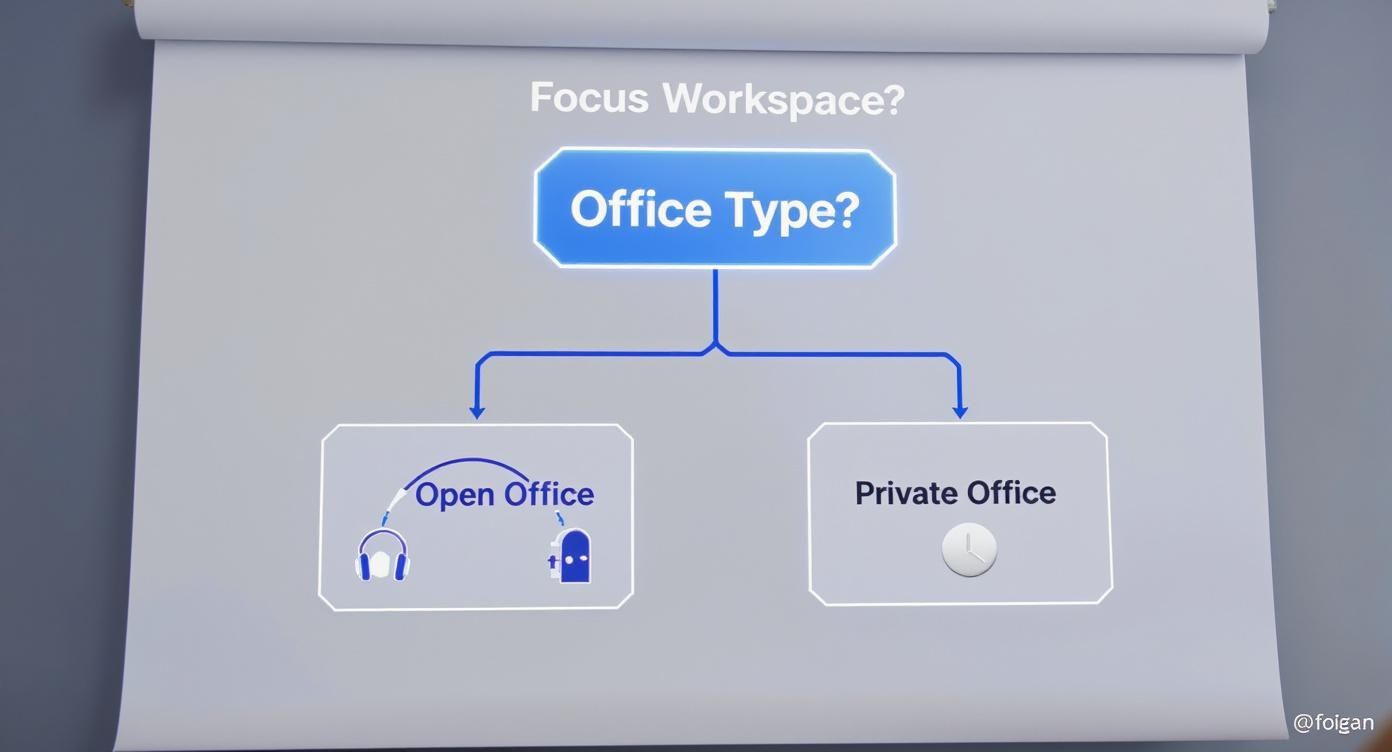
The visualization shows that while an open office may require more tools to block out noise, any environment can be optimized for focus with the right structure.
Comparing Focus Techniques: Pomodoro vs. Time-Blocking
So, which method should you choose? Both the Pomodoro Technique and time-blocking are powerful, but they cater to different work styles and goals. Understanding their core differences can help you pick the right one for you, or even combine them.
| Feature | Pomodoro Technique | Time-Blocking | Key Insight & Actionable Advice |
|---|---|---|---|
| Core Dynamic | Energy Management: Uses short sprints and mandatory breaks to prevent burnout and maintain stamina. | Time Protection: Proactively allocates every minute of the day to a specific task, creating a defensive calendar. | Insight: Pomodoro trains your ability to focus, while Time-Blocking protects the opportunity to focus. Action: Use Pomodoro within your Time Blocks for maximum effect. |
| Flexibility | Highly flexible; can be applied to almost any task throughout the day. | Less flexible once the day is planned; requires proactive scheduling. | Insight: Pomodoro adapts to your day; Time-Blocking structures it. Action: On chaotic days, rely on Pomodoro. On predictable days, use Time-Blocking. |
| Primary Benefit | Overcomes procrastination and builds focus endurance. | Ensures high-priority tasks get done by creating dedicated, uninterrupted time. | Insight: One is for getting started, the other is for getting finished. Action: Use Pomodoro to tackle a task you dread. Use Time-Blocking for your most critical projects. |
| Main Challenge | The frequent breaks can sometimes interrupt deep flow states. | Can feel rigid and doesn’t easily accommodate unexpected urgent tasks. | Insight: Both systems can feel restrictive if applied too rigidly. Action: Schedule a “flex block” in your Time-Blocking for unexpected tasks. Skip a Pomodoro break if you’re in deep flow. |
Ultimately, there’s no single “best” method. The Pomodoro Technique is fantastic for building your focus muscle and getting started on tasks you’ve been avoiding. Time-blocking excels at structuring your entire day for peak productivity. Don’t be afraid to experiment—you might use time-blocking to schedule your overall day and then use Pomodoros within your “deep work” blocks for added structure.
Building the Mental Habits for Deep Focus
All the external tweaks in the world—the clean desk, the noise-canceling headphones, the scheduled work blocks—can only take you so far. True, lasting focus is an inside job. The real foundation for staying locked in on your work is built within your own mind, moving beyond tactics to train your brain to resist distractions by default.
To get there, you first need to understand a frustrating little concept called attention residue. Think about it: you’re deep into a report, you quickly check one email, and then you jump back to the report. It feels harmless, but a piece of your attention gets left behind, still stuck on that email. This mental fog is the real cost of multitasking. It fragments your focus, ensuring you’re never fully present in what you’re doing.

The only way to fight this is to embrace deliberate single-tasking. And this isn’t just about doing one thing at a time; it’s a commitment to wiping the mental slate clean before you even begin.
Creating Your Attention Anchors
To combat attention residue, you need a way to signal to your brain that it’s go-time. This is where attention anchors come in—small, repeatable rituals that act like a mental reset button before you dive into a task.
Your anchor doesn’t need to be complicated. In fact, simpler is better. Before starting a deep work session, you could:
- Take three slow, deliberate breaths.
- Straighten the single notebook and pen on your desk.
- Put on a specific “focus” playlist (instrumental music works wonders).
- Set a physical timer on your desk and watch it start.
The action itself isn’t what matters. Consistency is everything. This tiny ritual trains your brain, forging a powerful link between the anchor and the state of deep focus that follows.
By creating a pre-task ritual, you’re not just preparing to work—you’re actively clearing out the mental clutter from your last task. This simple habit makes the transition into deep concentration smoother and faster.
The Power of a Distractions List
Look, even with the best intentions, your mind is going to wander. An internal thought (“Oh shoot, I need to buy milk”) can be just as jarring as a Slack notification. The trick isn’t to fight these thoughts, but to manage them with a distractions list.
Keep a simple notepad or a sticky note next to you. Whenever an unrelated thought, to-do, or urge pops into your head, just quickly jot it down. Then, immediately turn your attention back to your primary task.
This simple act of offloading the thought acknowledges it without surrendering your focus. You’re telling your brain, “I hear you, I’ve captured it, we’ll deal with it later.” This is especially crucial if you find yourself compulsively checking certain apps. If that’s a constant battle, learning some practical strategies on how to break social media addiction can help you reclaim that mental bandwidth for good.
These two mental habits—attention anchors and distraction lists—are your core toolkit for training your focus muscle. They transform concentration from a fleeting, unreliable state into a skill you can call upon whenever you need it.
Navigating Workplace Culture and Your Focus
You can have the most dialed-in personal focus routine on the planet, but it will fall apart in a day if your company’s culture is actively working against you. Your ability to concentrate isn’t just about willpower; it’s hugely influenced by the unspoken rules of your workplace. The constant pings, back-to-back meetings, and the pressure to be “always on” can build a battlefield for your attention.
When a company runs on a culture of constant availability, it creates an environment of perpetual distraction. The expectation to reply to every Slack message or email instantly trains our brains to stay in a state of high alert, making deep, concentrated work almost impossible. This isn’t just a frustration—it’s a massive economic drain.
Gallup’s State of the Global Workplace 2024 report found that a shocking 21% of employees feel engaged at work. This disengagement leads to an estimated $438 billion in lost productivity every year. Why? Because engaged teams are 14% more productive. Engagement is tied directly to having a sense of purpose and psychological safety—the very things that allow people to invest their full attention without fear. You can learn more about the connection between engagement and productivity from Archie’s detailed analysis.
Shifting from Constant to Intentional Communication
A culture that truly values deep work has to ditch the “sync-first” mindset, where every question demands an immediate answer. This is where asynchronous communication becomes your most powerful tool.
Instead of firing off an instant message for every little thing, encourage detailed emails or comments within your project management tool. This simple shift gives people the space to think and respond thoughtfully on their own schedule, preserving precious blocks of uninterrupted time for everyone involved.
But for this to actually work, it has to be a team-wide agreement.
- Establish Clear Channels: Define which tools are for true emergencies (maybe a phone call) versus non-urgent updates (email or Asana).
- Set Response Expectations: Agree on realistic response times, like “within 24 hours,” to take the pressure off instant replies.
- Model the Behavior: This is critical. Leaders have to walk the walk by respecting focus time and using async channels themselves.
A culture that protects focus is one that says, “Your uninterrupted time is valuable to us all.” It’s a collective understanding that the best work happens when people are given the space to do it.
Advocating for a Focus-Friendly Culture
Whether you’re a manager or an individual contributor, you can take small, practical steps to build a more focus-friendly environment. It really just starts with advocating for your own concentration and, in doing so, making it easier for others to protect theirs.
If you’re an employee, this might look like blocking out “focus time” on your public calendar and being upfront about your unavailability. If you’re a manager, you could establish a “no-meeting Wednesday” or encourage the team to rely more on status updates in Slack to cut down on interruptions.
The Digital Detox App can be a huge ally in this cultural shift. It allows teams to schedule and share their focus sessions. When your colleagues can see you’re in a “deep work” block, they’re far more likely to respect that boundary. This builds a shared language around focus, making it a visible—and respected—part of the team’s workflow and a key step in learning how to keep focus on work.
Troubleshooting Common Focus Killers
Even the most perfectly planned day can get thrown for a loop. We’ve all been there. Knowing how to keep focus on work isn’t just about setting up the right environment; it’s about knowing how to get back on track when things inevitably go sideways.
Think about it: you’ve carved out two solid hours for a deep work session, and then a coworker pops by your desk with an “urgent” request that completely shatters your concentration. Or maybe a tense meeting leaves you feeling so drained you can’t imagine focusing on anything complex. These moments don’t have to derail your entire day. You just need a game plan.
Handling Unplanned Interruptions
When a colleague breaks your flow, the goal is to protect your time without torpedoing your work relationships. It’s a delicate balance, but a simple script can work wonders.
Instead of getting flustered, try saying something firm but polite: “I’m right in the middle of something that needs my full attention. Can I circle back with you in about an hour when I hit a good stopping point?”
This little phrase does two things beautifully. It acknowledges their request as valid, but it also reinforces that what you’re doing right now is the priority. It’s a small adjustment that puts you back in control of your schedule.
One of the biggest unseen challenges to our focus is the sheer volume of information we face daily. To get a handle on it, check out this guide on What Is Information Overload and How to Beat It.
Resetting After a Focus Break
So, what happens when you look up and realize you’ve spent the last 20 minutes scrolling through social media? The key isn’t to beat yourself up over it. It’s to execute a quick, decisive reset.
- Acknowledge it, don’t judge it. The moment you realize you’re distracted, just notice it. No need for guilt.
- Make a physical shift. Stand up. Stretch. Go grab a glass of water. This simple physical action helps break the mental trance you were in.
- Reconnect with your “why.” Before diving back in, take ten seconds to remind yourself why this task matters. What’s the goal?
If you find your phone is the usual culprit behind these focus breaks, it might be a sign of a more ingrained habit. Sometimes, we all need a little extra support to build a healthier relationship with our devices. Looking into dedicated phone addiction help can offer some powerful tools to reclaim your attention.
Ultimately, troubleshooting focus killers isn’t about achieving a perfect, uninterrupted day. That’s a fantasy. It’s about building a resilient system that helps you recover quickly and get back to what matters.
Answering Your Toughest Focus Questions
Let’s tackle some of the most common questions that come up when you start getting serious about reclaiming your attention. These are the real-world sticking points many of us face.
How Long Does It Really Take to Build a Strong Focus Habit?
This is the million-dollar question, isn’t it? While it’s different for everyone, you’ll likely start feeling a real shift after a few weeks of consistent effort. The secret here is consistency, not intensity.
Forget trying to lock in for three hours on day one. Start with something that feels almost too easy, like a single 25-minute Pomodoro session. Once that feels comfortable, add another. The goal is to build momentum through small, repeatable wins that make the habit stick.
My Job Is Nothing but Interruptions—What Then?
I hear this a lot, especially from people in roles like customer support or team management where being reactive is part of the job description. In these cases, those long, uninterrupted deep work blocks just aren’t going to happen.
So, you pivot. Instead of aiming for deep work marathons, go for “focus sprints.”
Look for those small, 15-20 minute gaps between the chaos. Can you knock out one specific project task? Can you clear a backlog of administrative work? A great move is to update your team chat status to something like, “Heads down for 15 mins.” It’s a simple way to manage expectations and guard those precious pockets of time.
Is Music a Focus-Booster or a Focus-Killer?
The honest answer? It depends entirely on you and what you’re working on. For those repetitive, almost-on-autopilot tasks, the right music, usually something instrumental or ambient—can be a huge help for both your focus and your mood.
But when you’re wrestling with a complex problem or doing anything that involves heavy-duty language processing (like writing a detailed report), music often just becomes one more distraction your brain has to filter out.
You have to be your own scientist here. Experiment with different soundscapes. Try a white noise generator, some lyric-free electronic beats, or even the hum of a quiet room. See what actually helps you lock in, because the perfect audio environment is one of the most personal parts of building focus.
Ready to turn these ideas into action? The Digital Detox App gives you the simple, practical tools you need to build a stronger focus habit and forge a healthier relationship with your technology. Start reclaiming your attention today at https://digitaldetoxapp.com.