How to Concentrate While Studying: A Proven Guide
To truly concentrate while studying, you must master two domains: your external environment and your internal attention. The strategy involves minimizing distractions around you and then applying structured techniques, like time blocking, to manage your focus.
This guide provides an actionable breakdown of how to build a focused study routine. We’ll cover how to engineer your space, master proven focus techniques, and tame your digital devices to transform overwhelming tasks into manageable achievements.
Why Staying Focused While Studying Feels Impossible
Ever find yourself staring at the same page of a textbook for twenty minutes, only to realize you haven’t absorbed a single word? You’re not alone. The modern study environment is a battlefield for your attention.
Between the constant pull of digital notifications and the internal pressure to perform, maintaining focus can feel like a monumental task. For many students, this struggle is a significant barrier to effective learning, making them understand why focus feels impossible.

Often, the biggest culprits are buzzing in your pocket or sitting on your desk. A 2023 report from the American Psychological Association found that 68% of students felt overwhelmed by digital interruptions, which slashed their effective study concentration by up to 40%. That constant buzz from your phone isn’t just a minor annoyance; it’s a major roadblock to deep learning.
Before we dive into solutions, let’s pinpoint the most common focus-killers. This table breaks down the problem areas and provides an immediate, actionable fix.
Common Concentration Killers and Quick Fixes
| Problem Area | Quick Solution |
|---|---|
| Phone Notifications | Turn on “Do Not Disturb” mode and place your phone face down in another room. |
| Cluttered Desk | Take 5 minutes to clear your desk, leaving only essential study materials. |
| Noisy Environment | Use noise-canceling headphones or play ambient study music. |
| Vague Study Goals | Before starting, define one specific, small task to complete (e.g., “Read Chapter 3, Section 1”). |
| Digital Distractions (Web) | Use a browser extension like Freedom or StayFocusd to block distracting sites for a set time. |
| Physical Discomfort | Adjust your chair and lighting for comfort; take a 2-minute stretch break. |
These quick fixes can make a surprising difference right away, but building sustainable focus requires digging a bit deeper into your habits and environment.
Pinpointing the Main Distractions
Beyond your devices, your physical space plays a massive role. A cluttered desk, poor lighting, or an uncomfortable chair can create a low-level stress that drains your mental energy without you even realizing it. These subtle environmental factors accumulate, making it significantly harder to enter a state of deep focus.
The core issue isn’t a lack of willpower; it’s a lack of a system. By addressing the root causes of distraction, you can reclaim your ability to concentrate effectively and make your study time count.
This guide provides a clear roadmap to do just that. We’ll cover actionable strategies to help you engineer a distraction-proof environment and use proven techniques like the Pomodoro method. Sometimes, a full reset is what’s needed, and exploring the benefits of a digital detox can be a powerful way to reclaim your attention span.
The goal is to give you a few quick wins right from the start, showing you how to take back your focus and make every study session count.
Engineer a High-Focus Study Environment
Your study space is more than just a desk and a chair. Think of it as an active tool that can either build your focus or systematically tear it down. This isn’t just about tidying up; it’s about consciously designing a space that sends a clear signal to your brain: it’s time for deep work.
The goal is to reduce mental friction. When your environment is chaotic, your brain wastes precious energy just trying to ignore all the distractions around you, leaving less power for actual learning. A well-designed space, on the other hand, makes concentration the path of least resistance.
The Science of a Distraction-Free Zone
Creating a true focus zone starts with managing your sensory input—what you see, hear, and feel. A cluttered desk isn’t just messy; it’s a minefield of visual distractions, each one a tiny, unanswered question pulling at your attention. That pile of mail, the snack wrapper, the book you meant to return last week—they all compete for cognitive resources.
The same principle applies to sound. An unpredictable noise, like a roommate’s conversation or a TV blaring in the next room, can instantly derail your train of thought. Controlling these elements isn’t about creating a sterile, perfect bubble. It’s about engineering a predictable, low-stimulation environment where your mind can finally settle down and get to work.
Your brain interprets a clean, organized workspace as a calm, manageable task. A cluttered one, however, can trigger feelings of being overwhelmed before you even begin, making it that much harder to start studying.
Optimize Your Physical Space for Peak Performance
Making a few intentional tweaks to your physical setup can pay huge dividends for your focus. It doesn’t have to be complicated.
- Designate a Study-Only Area: If possible, dedicate a specific desk or corner solely for studying. This builds a powerful psychological association. Over time, simply sitting in that spot will prime your brain for work mode.
- Face a Wall, Not a Window: Natural light is beneficial, but facing a window is like having a live-action distraction channel running all day. Position your desk to face a blank wall to minimize unexpected movements and keep your focus contained.
- Clear Your Desk, Clear Your Mind: Before each study session, take two minutes. Set a timer. Remove everything that isn’t essential for the task at hand. All you should see is your textbook, a notebook, and a pen. This simple ritual eliminates countless potential distractions.
Let There Be (the Right) Light and Sound
The quality of light and sound in your study space has a direct, measurable impact on your cognitive performance. This isn’t just a hunch; environmental psychology research has consistently shown how these elements influence alertness and attention.
For instance, one study involving over 1,200 students found that access to natural light can boost focus by as much as 26%. The shocking part? More than half of students study in dimly lit rooms. Old-school data also reveals that physical clutter can slash your attention by 18%, proving that a clean desk literally helps quiet your mental noise. You can discover more about these environmental findings if you’re curious.
So, how do you put this into practice? Position your desk near a window to catch as much daylight as possible. For evening sessions, use a cool-toned LED desk lamp—it mimics daylight and helps promote alertness. When it comes to sound, a good pair of noise-canceling headphones can be a lifesaver. If total silence feels more eerie than peaceful, try an app that plays white noise or ambient sounds like rain. It’ll mask disruptive background noise without becoming a distraction itself.
Master Your Attention With Proven Focus Techniques
Getting your study space right is half the battle, but the real magic happens when you learn to direct your attention. Think of concentration less as a gift you’re born with and more as a muscle. The more you train it with the right exercises, the stronger and more reliable it becomes—especially when you’re staring down a dense chapter on organic chemistry.
These aren’t about brute-forcing your way through a study session. Instead, they’re smart structures that play to your brain’s natural rhythms. They help you manage your energy, sidestep that nagging urge to procrastinate, and make a three-hour study marathon feel like a series of manageable sprints.
The Power Of Time-Based Techniques
Some of the most powerful focus strategies are all about slicing up your time. Instead of looking at a huge, intimidating block of study time, you create short, contained bursts of effort that feel way more approachable. This simple trick short-circuits the brain’s classic “this is too big, I’ll do it later” response.
The most famous of these is the Pomodoro Technique. It works by breaking study sessions into focused 25-minute intervals separated by short breaks. You work without interruption for 25 minutes, then take a mandatory 5-minute break. After four cycles, you take a longer 15-30 minute break.
The secret to the Pomodoro isn’t just the 25 minutes of work. It’s the mandatory five-minute break. This allows your brain to reset and consolidate information, preventing the burnout that kills so many study sessions.
Before you dive into a focus technique, it’s always a good idea to make sure your environment is actually ready for it. This flowchart gives you a quick way to diagnose and fix your space.
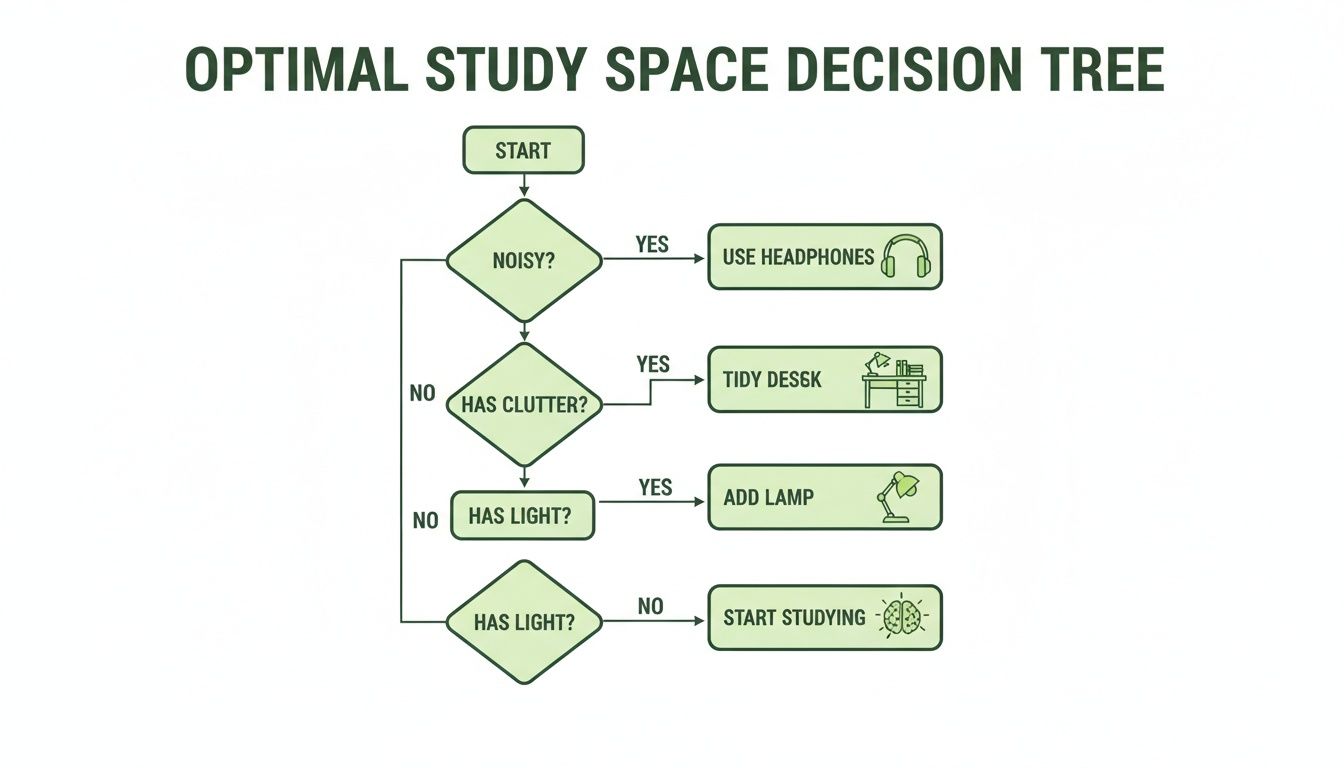
As you can see, a few simple checks for things like noise, clutter, and lighting can make or break your ability to use these focus methods effectively.
Beyond Pomodoro, other time-based methods have their own strengths. Time blocking, for instance, is where you schedule your entire day into specific blocks for every single task. It’s less about short sprints and more about building a fortress around your time, which is a game-changer when you need to keep your focus on work and school without everything blurring together.
Comparison: Pomodoro vs. Time Blocking
Choosing the right technique depends entirely on the task at hand. Using the wrong tool for the job leads to frustration. This comparison breaks down the key differences, benefits, and ideal scenarios for two of the most effective methods.
| Aspect | Pomodoro Technique | Time Blocking |
|---|---|---|
| Structure | Short, timed sprints (25 mins) with mandatory short breaks. | Pre-planned blocks of time dedicated to specific tasks on a calendar. |
| Best For | Tasks requiring high mental energy in short bursts: memorization, problem sets, reviewing notes. | Large, complex projects requiring sustained focus: writing essays, research, multi-step assignments. |
| Primary Benefit | Prevents burnout and keeps energy high. The short intervals make daunting tasks feel manageable. | Eliminates decision fatigue and protects study time from interruptions and multitasking. |
| Key Implication | Encourages a rhythm of work and rest, which is excellent for memory consolidation. | Promotes a proactive, disciplined approach to managing your entire schedule, not just study time. |
The key insight is this: Pomodoro is about managing your energy, while Time Blocking is about managing your time. Experiment with both to see which aligns better with your study needs and personal style. It’s all about how to study smarter, not harder by finding a system that works with your brain, not against it. The best technique is always the one you’ll actually stick with.
How to Tame Your Digital Distractions
Let’s be honest: your phone and laptop aren’t neutral tools. They’ve been meticulously designed by some of the smartest people in the world to grab your attention and keep it. So, if you’re struggling to focus while studying, it’s not a personal failing—it’s the result of fighting a battle against a system designed for you to lose.
Reclaiming your focus isn’t about throwing your devices away. It’s about flipping the script from being a passive user to being the one in control. Simply silencing notifications is a decent first step, but it doesn’t get to the heart of the problem—that automatic, muscle-memory twitch to grab your phone at the first sign of boredom. To really get a handle on these digital diversions, you need to be more strategic.

Create Intentional Friction
The single most powerful tactic you can use is to make your distractions harder to get to. Every single extra step you put between yourself and a time-wasting app is a chance for your rational brain to jump in and say, “Wait, is this really what I want to be doing right now?”
This idea is called “creating friction,” and it’s brilliant for breaking those mindless habits. The whole point is to make opening TikTok or Instagram a conscious choice, not a knee-jerk reflex.
- Log Out of Everything: Don’t just close the app. Actually log out of your social media accounts. Having to type in your password every single time you want to check your feed adds just enough of a barrier to make you question if it’s really worth the hassle.
- Use App Blockers Like You Mean It: Tools like Freedom or Forest are non-negotiable for serious study. Set them up to block distracting sites and apps during your scheduled focus time. This basically outsources your willpower, saving that precious mental energy for your actual coursework.
- Physically Move Your Phone: Don’t just flip it face down on the desk. That’s not enough. Put it in another room. The physical distance means you have to get up and walk to check it, which completely breaks your study flow and gives you a powerful moment to reconsider.
By making your biggest distractions inconvenient, you turn your environment into an ally. This isn’t about a head-on battle with temptation; it’s about redesigning your space so temptation rarely even gets an invitation.
Implement a Digital Sunset
That blue glow from your screens does more than just tire out your eyes. It directly messes with your sleep quality, which in turn torpedoes your ability to concentrate the next day. A “digital sunset” is a simple but incredibly effective routine to fight back.
Make a commitment to shut down all screens—phone, laptop, tablet, TV—at least 60 to 90 minutes before you plan to go to sleep. This gives your brain the signal to start winding down, which not only helps you fall asleep faster but also improves the quality of that sleep, helping to lock in what you studied.
Learning about different ways to reduce screen time can give you some great, structured ideas for making this a real habit. Try swapping that last hour of scrolling for reading a real book, doing some light stretching, or journaling. It’s a simple boundary that protects both your sleep and your grades.
Align Your Study Schedule with Your Brain’s Rhythm
Studying hard is one thing. Studying smart is something else entirely. A huge part of learning to concentrate is realizing your brain isn’t a machine you can just switch on. It runs on its own internal clock—a natural cycle of energy peaks and troughs called your circadian rhythm.
Instead of fighting that rhythm with brute force and another cup of coffee, you can learn to work with it. When you align your schedule to your brain’s natural flow, studying stops feeling like a battle against fatigue. It becomes a more efficient, natural process, letting you get more done in less time.
Morning Larks vs. Night Owls: What’s Your Chronotype?
First things first, you need to figure out your chronotype. This is just a fancy word for your body’s natural tendency to sleep and be alert at a certain time. You probably already have a gut feeling about whether you’re a “morning lark” who’s sharpest early in the day, or a “night owl” who really hits their stride in the evening.
Neither is better or worse, but knowing your pattern is everything. Forcing a night owl to cram for a complex exam at 7 AM is just as pointless as asking a morning lark to write an essay at midnight. Honoring your chronotype means scheduling your most demanding subjects when your brain is already primed for peak performance.
Recent research on circadian rhythms shows just how mismatched most students’ schedules are. One 2024 survey revealed that while 62% of students are at their best between 10 AM and 2 PM, only 24% actually use that time to study because of classes and other commitments.
Even more telling, a separate experiment found that students who shifted their study sessions just two hours to better match their personal energy peaks saw a 25% gain in focus. Discover more insights from this study on student performance trends.
Aligning your study sessions with your chronotype isn’t about finding more time; it’s about making the time you have more powerful. Working with your brain’s natural rhythm reduces mental friction and makes deep concentration feel less like a chore.
How to Structure Your Day for Maximum Focus
Once you’ve identified your peak hours, you can start building a much more strategic study schedule. The whole game is matching the difficulty of a task with your available mental energy.
High-Energy Hours for High-Demand Tasks: This is your prime time. Schedule your most difficult subjects—like calculus, physics, or that dense philosophy reading—for these peak focus windows. Your brain is best equipped for heavy-duty problem-solving and critical thinking right now.
Low-Energy Hours for Low-Demand Tasks: Use your energy slumps for the more passive or administrative stuff. This is the perfect time to organize notes, flip through flashcards, answer a few emails, or plan your next study session.
This simple shift stops you from wasting your best mental hours on menial tasks. It also prevents that awful burnout feeling you get from trying to tackle difficult material when your brain is already running on empty. It’s a small change that makes a world of difference.
Troubleshooting Your Focus: A Q&A
Even with the best game plan, some days your focus just won’t cooperate. That’s completely normal. The real secret to building rock-solid concentration isn’t about being perfect; it’s about knowing how to get back on track when you get derailed. Here are some of the most common questions—and practical answers—for when your focus feels flimsy.
What Should I Do When My Mind Keeps Wandering?
First, take a breath. Your mind is supposed to wander. The goal isn’t to force it into a perfectly silent, Zen-like state. It’s to get better and faster at noticing when you’ve drifted off and gently calling your attention back home.
Instead of getting frustrated, think of it as doing a rep for your focus muscle. The moment you catch yourself thinking about dinner plans or that awkward thing you said yesterday, just acknowledge it. No judgment. Just a simple, “Ah, there’s that thought.” Then, softly guide your focus back to the textbook.
The real skill of concentration isn’t about never losing focus. It’s about shortening the time it takes to realize you’ve lost it. Each time you redirect your attention, you’re strengthening the neural pathways responsible for focus.
Does Listening to Music Actually Help or Hurt?
This is the million-dollar question, and honestly, the answer is: it depends. Research is all over the place, but the general consensus is that music can boost your mood and lower stress, which is great for learning. The catch? The wrong kind of music can absolutely sabotage your study session.
Finding what works for you is a process of trial and error.
- For dense reading or complex problem-solving: Lyrics are your enemy. They actively compete for the same language-processing real estate in your brain that you need for the task. Stick with instrumental music—think classical, lo-fi beats, cinematic scores, or even ambient nature sounds.
- For rote memorization or creative tasks: Music with a familiar, steady rhythm can actually be a huge help. A good tempo can help with memory recall, and an energizing playlist might be just what you need to kickstart a brainstorming session.
- When in doubt, run an experiment: Don’t just guess. Be a scientist. Try studying in total silence for a few sessions. Then try a few with ambient noise, and a few with your favorite instrumental playlist. Track how you feel and how much you accomplish. The data won’t lie.
How Can I Stay Focused on Boring Material?
Let’s be real—not every chapter of organic chemistry is going to feel like a gripping novel. When you’re staring down a topic that could put a pot of coffee to sleep, you have to change your approach. Brute force won’t work.
One of the most effective tricks is to gamify it. Challenge yourself to distill a ridiculously dense paragraph into a single, tweet-length sentence. Or turn it into a scavenger hunt: find one genuinely interesting fact on each page. It sounds silly, but it shifts your brain from passive reception to active engagement.
Another powerful technique is to find a personal hook. Try to connect the dry material to something you actually care about. If you’re bored by a historical text, can you find a parallel to a movie you love or a current event that’s blowing up your feed? Forging these personal connections makes the information stick and transforms a mind-numbing task into something, well, almost interesting.
Ready to take control of your digital distractions and build unbreakable focus? The tools from Digital Detox App are designed to help you create intentional boundaries with your technology, so you can reclaim your time and attention for what truly matters. Start building healthier tech habits for free.