How to Stop Social Media Addiction: A Complete Guide
Breaking a social media addiction isn’t just about putting your phone away. It’s about understanding the psychological hooks that keep you scrolling, identifying your personal triggers, and then systematically building a healthier relationship with technology. This guide offers a complete breakdown of the problem, the benefits of change, and actionable insights to help you regain control.
Why You Can’t Stop Scrolling: The Dynamic of Addiction
The feeling that you should put your phone down but just can’t is not a personal failure; it’s a result of brain chemistry and intentional design. Social media platforms are engineered to be irresistible, leveraging the same psychological principles that make slot machines addictive.
This is driven by a dopamine loop. Dopamine is the brain’s reward chemical, creating feelings of pleasure and motivation. Every like, comment, or new post is a small, unpredictable reward that delivers a dopamine hit, creating a powerful feedback cycle that trains your brain to equate scrolling with pleasure.
The Science of the Infinite Feed
Think of your social media feed as a digital slot machine. It operates on a variable reward schedule. You never know which refresh will reveal a viral video or a message from a friend. This unpredictability is the core of the addiction dynamic, keeping your brain hooked and constantly chasing the next potential reward.
Neuroscientists have found that our brain’s reward centers also light up when we share information about ourselves—the primary activity on social media. This self-disclosure feels good, reinforcing the entire cycle of posting and checking.
The implications are significant. It’s estimated that around 210 million people worldwide will struggle with social media addiction by 2025. Platforms like TikTok and YouTube have mastered algorithms that serve an endless stream of dopamine-triggering content. This isn’t harmless fun; excessive use has been linked to a staggering 63% increase in depression and a 47% rise in anxiety.
The real issue isn’t just the hours we lose. It’s the quality of that time. Compulsive scrolling often takes the place of real human connection and fulfilling activities, leaving a void that these platforms are perfectly designed to fill—but only for a moment.
How a Habit Becomes a Compulsion
A simple habit escalates into a compulsion when scrolling becomes your primary coping mechanism for difficult emotions like boredom, loneliness, or stress. Instead of addressing the root cause of these feelings, you reach for your phone for a quick, temporary escape.
Over time, this erodes your ability to tolerate discomfort and be present in your own life. You might find yourself checking your phone during conversations, at dinner, or even in the middle of the night. This indicates that the digital world is taking precedence over your real one. Understanding the powerful benefits of a social media detox can provide the motivation needed to reclaim your attention.
The first step is recognizing these patterns. The goal isn’t to demonize technology, but to become a conscious user. Once you understand the ‘why’ behind your scrolling, you can finally break the cycle.
Quick Guide to Spotting Compulsive Social Media Use
This table breaks down the key signs of compulsive use and provides actionable first steps. This is a comparison of problematic behaviors versus intentional responses.
| Symptom of Compulsive Use | First Actionable Step to Take |
|---|---|
| Feeling anxious or irritable when you can’t check your phone. | Turn off non-essential notifications for 24 hours to reduce the constant pull. |
| Mindlessly scrolling for long periods without realizing it. | Set a timer for 15 minutes before you open your most-used app. |
| Checking social media first thing in the morning and last thing at night. | Charge your phone in another room overnight. Use a real alarm clock. |
| Prioritizing online interactions over face-to-face conversations. | Designate one “phone-free” zone in your home, like the dinner table. |
| Neglecting hobbies or responsibilities in favor of screen time. | Plan one specific, screen-free activity you enjoy and schedule it into your week. |
| Your mood depends on the likes, comments, or shares you receive. | Take a 48-hour break from posting anything new. Focus on consuming less and connecting more. |
Honestly assessing your behaviors is a critical first step. It’s not about judgment; it’s about awareness. This is where real change begins.
Crafting Your Personal Digital Detox Plan
Moving from knowing you have a problem to doing something about it is the most important step. A vague goal like “use social media less” is ineffective. You need a concrete, personal plan—a clear roadmap for taking back your time and attention. This isn’t about deprivation; it’s about empowerment.
The first move is a simple self-audit. To break a habit, you must understand its trigger. For the next two days, pay close attention to the moments you instinctively reach for your phone to open a social media app. Observe without judgment.
Pinpoint Your Personal Triggers
Your triggers are the specific feelings, situations, or times of day that initiate a mindless scrolling session. Identifying them exposes the weak link in the addiction cycle, allowing you to get ahead of the impulse.
What’s happening in those moments?
- Boredom: Waiting in line, sitting in traffic, or during a commercial break?
- Loneliness: Scrolling when you’re alone at night or during a quiet moment?
- Anxiety or Stress: Using Instagram as an escape from overwhelming work or a difficult conversation?
- FOMO (Fear of Missing Out): Checking your phone after a social event or seeing friends post about something you weren’t invited to?
Jot down your top two or three triggers. This self-awareness is the foundation of a successful detox.
This whole process is designed to keep us hooked in a simple, powerful loop.
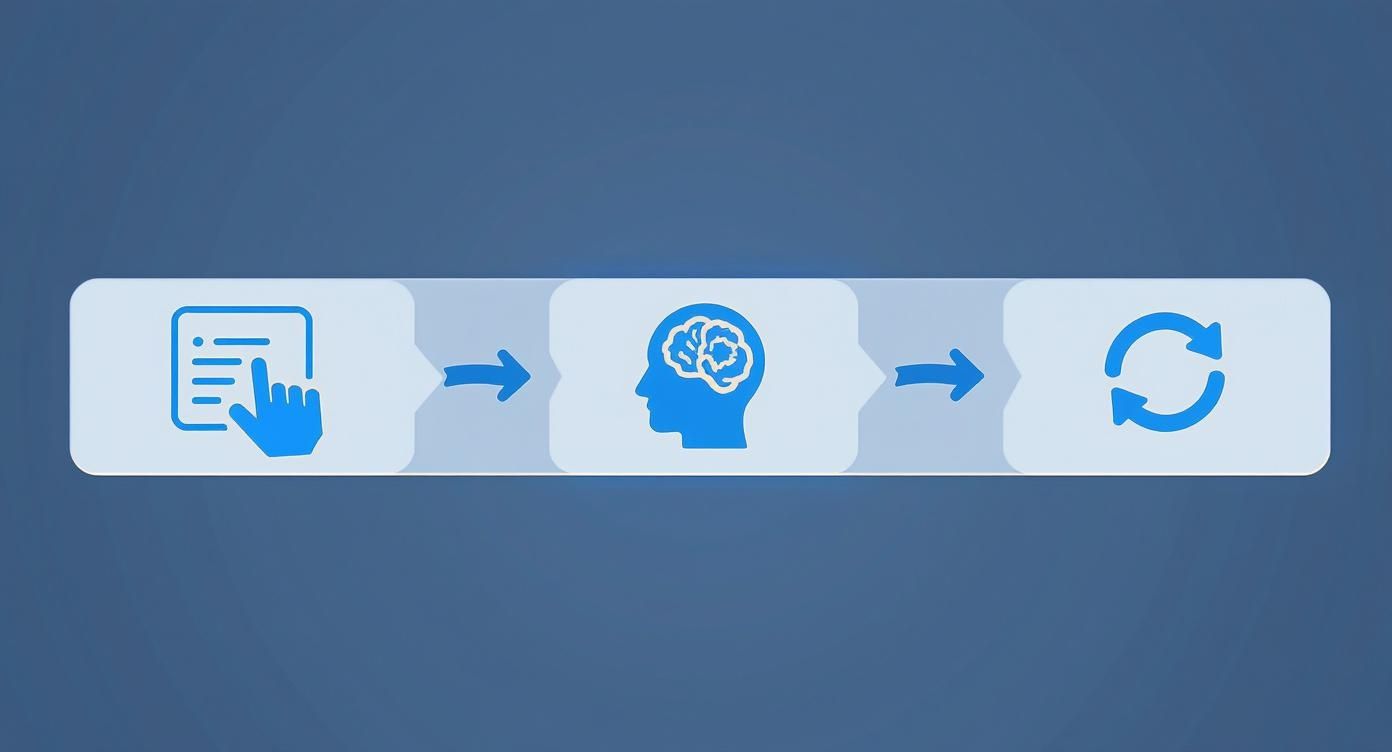
That simple scroll-reward-loop is precisely why knowing your personal triggers is so critical. It’s your key to breaking the cycle.
Set Clear and Achievable Goals
With your triggers identified, set specific, measurable, and realistic goals. Forget a dramatic overhaul; aim for small, incremental changes that build momentum and provide motivating wins.
Here are some examples of strong, actionable goals:
- No phone for the first 30 minutes of the day. Wake up to your own thoughts, not someone else’s feed.
- Delete one distracting app for a week. Remove your biggest time-waster for seven days and observe the effect.
- Unfollow five accounts that cause stress each weekend. Actively curate your feed to be a more positive space.
- Designate a “phone-free” zone. Make the dinner table or your bedroom a device-free area.
The most effective digital detox plans are built on conscious choices, not deprivation. Each small boundary you set reclaims a piece of your attention and proves that you are in control of your technology, not the other way around.
Deliberate social media breaks are becoming more common. As of 2025, about one in three social media users have attempted to reduce their screen time. Considering 38% of users admit they can’t go more than a few hours without checking their feeds, it’s clear that setting usage limits is becoming essential.
Create Your “If-Then” Response Plan
This is a game-changing psychological tool for replacing an old habit with a new one. An “if-then” plan creates a pre-planned, healthier response linked directly to your trigger, automating your decision-making when a craving hits.
Using your identified triggers, build your “if-then” statements.
Triggers vs. “If-Then” Responses
| If I Feel… (The Trigger) | Then I Will… (The New Action) |
|---|---|
| Bored while waiting in line | Read two pages of a book on my Kindle app |
| Lonely and tempted to scroll before bed | Write three things I’m grateful for in a journal |
| Overwhelmed by work and want to escape | Stand up, stretch, and walk around the room for two minutes |
| FOMO after seeing a friend’s post | Text a different friend to make a plan to connect in person |
This strategy flips the script from being reactive to being proactive. You become the architect of your responses, not a victim of the scroll.
For those ready to dive in, a structured program like our 7-Day Digital Detox Challenge can provide the perfect framework to put these plans into action, making the process feel much less overwhelming.
How to Re-Engineer Your Digital Environment
Mindless scrolling is not a choice; it’s a consequence of an environment engineered to capture and hold your attention. To break free, you must stop passively accepting this design and actively re-engineer your digital world to serve your intentions, not the algorithms.
The goal isn’t to get rid of your phone but to make it a less enticing escape. By adding small, strategic points of friction, you transform an unconscious habit into a conscious choice.
Tame Your Notifications and Timers
Constant notifications are strategic interruptions designed to pull your attention back to an app. Disabling them is one of the most powerful changes you can make. Go into your phone’s settings and turn off all non-essential notifications for social media and other non-critical apps. Keep alerts for texts and phone calls, but silence the rest.
Next, use app timers. Most smartphones have this feature built-in. Set a firm limit—like 30 minutes a day for your biggest time-sink—and let the phone enforce it. When the timer runs out, the app locks, providing a hard stop that requires no willpower.
Think of your digital environment like your physical one. A calm, uncluttered room promotes focus and peace. A phone that isn’t constantly demanding your attention does the same for your mind.
Reorganize Your Home Screen for Intentionality
Your home screen is prime real estate. If addictive apps are front and center, opening them becomes a muscle-memory reflex. Disrupt this automatic behavior by reorganizing your app layout.
- Move Addictive Apps Off the Home Screen: Banish time-wasters to the second or third page, or bury them in a folder labeled “Mindless.” This extra step forces a moment of conscious thought.
- Create a “Tools-First” Home Screen: Reserve your main screen for utility apps like your calendar, notes, maps, and camera. This reframes your phone as a functional tool, not an entertainment device.
- Use the Search Function: Instead of tapping an icon, get into the habit of searching for the app you want. This turns an impulse into an intentional action.
These small changes add a crucial layer of friction between the impulse and the action, giving your conscious mind a moment to catch up.
Make Social Media Less Visually Appealing
Social media platforms use vibrant colors and movement to keep your brain hooked. You can counteract this by stripping away these stimulating elements.
The grayscale setting is a game-changer. By turning your screen to black and white (usually found in accessibility settings), you make vibrant photos and videos look dull and uninteresting. The dopamine hit from a beautiful image disappears, making it easier to put your phone down.
Simultaneously, curate your feed with precision. Unfollow accounts that trigger envy, inadequacy, or anxiety. Actively follow content that educates, inspires, or connects you with others. This transforms your relationship with platforms from passive consumption to active, intentional engagement.
Finding Fulfilling Offline Alternatives to Scrolling
Kicking a compulsive habit isn’t just about stopping an old behavior; it’s about consciously starting a new one. Reducing scroll time creates a void that can pull you back into the old cycle. To truly break free, you must fill that space with meaningful offline activities that provide genuine fulfillment.
This is your chance to rediscover what you love beyond the screen. Think about what you used to enjoy—reading a book, painting, learning an instrument. These pursuits offer something social media can’t: a tangible sense of accomplishment and deep, personal satisfaction.

The key is to start small and be intentional. Don’t aim to write a novel overnight. The goal is simple: make direct swaps that replace screen time with real-world engagement.
The Dynamics of Dopamine: Offline vs. Online
Social media provides quick, unpredictable hits of dopamine. A like, a comment, a new post—it’s instant gratification. An offline hobby, in contrast, offers a different kind of reward. It’s a delayed-gratification dopamine system, which builds resilience and a much stronger sense of self-worth over time.
Let’s compare the two directly.
Online vs. Offline Reward Systems
| Aspect of Reward | Social Media Scrolling | Offline Hobby (e.g., Learning Guitar) |
|---|---|---|
| Effort Required | Minimal; just a flick of the thumb. | High; requires practice and patience. |
| Reward Speed | Instant; a new post appears immediately. | Delayed; satisfaction comes after mastering a chord. |
| Reward Quality | Fleeting and passive; you consume content. | Lasting and active; you create something. |
| Sense of Control | Low; the algorithm decides what you see. | High; you decide what to learn and create. |
This table highlights a critical difference. Online rewards are given to you, making you a passive recipient. Offline rewards are earned by you, making you an active creator. The latter builds skills, confidence, and a sense of purpose that a thousand “likes” can never replicate.
Embracing an offline alternative isn’t about finding a mere distraction; it’s about investing in activities that build you up. The goal is to find something so engaging that social media simply becomes less interesting by comparison.
Making Practical and Fulfilling Swaps
Instead of focusing on what you’re losing (time on social media), reframe it as what you’re gaining: time for yourself. Pinpoint specific scrolling moments and assign a new activity to them.
Here are a few practical swaps:
- Morning Scroll Swap: Instead of grabbing your phone first thing, spend those 15 minutes reading a chapter of a book, stretching, or making a proper cup of coffee without any digital distractions.
- Commute Scroll Swap: On public transport, listen to an engaging podcast or an audiobook. As a passenger, just look out the window and let your mind wander.
- Evening Scroll Swap: Replace that final hour of scrolling before bed with a short walk, journaling, or listening to calming music. This not only cuts screen time but dramatically improves sleep quality.
These small substitutions rewire your brain’s reward system, associating downtime with genuine relaxation and accomplishment. For more strategies, explore different ways to reduce screen time.
Keeping the Momentum: How to Maintain Your Progress and Prevent Relapse
You’ve done the heavy lifting and started to feel the benefits. But getting control over social media use isn’t a one-and-done fix; it’s like building a muscle that requires ongoing practice. This phase is about creating a long-term toolkit to stay on track, handle slip-ups, and build a resilient mindset.
The end game isn’t total avoidance. The goal is mindful engagement, where you use your phone with a clear purpose and put it down just as easily. That’s how you build a lasting, healthy relationship with technology.
Reframe Slip-Ups as Learning Moments
You will inevitably have a day where you lose an hour to scrolling. That’s not a failure—it’s data. Relapsing is a normal part of changing any deeply ingrained behavior.
The real danger is the “what-the-hell” effect: a spiral where one mistake makes you feel like you’ve failed, so you give up entirely. Don’t fall into that trap.
Instead, get curious. Treat a slip-up like a detective mystery:
- What was the trigger? Were you bored, stressed, or lonely? Pinpointing the root cause helps you build a better defense for next time.
- What can I tweak? Maybe an app timer needs to be stricter, or you need a new offline activity for that specific emotional gap.
- How can I be kinder to myself? Acknowledge what happened without self-criticism. Then, recommit to your goals for the next hour or the next day.
This perspective turns a moment of weakness into a powerful learning opportunity, strengthening your strategy.
Schedule Periodic Digital Check-Ins
You schedule regular check-ups for your health; your digital wellbeing deserves the same attention. Once a month, set aside 15 minutes to honestly review your relationship with your devices. This is about routine maintenance, not guilt.
During your check-in, ask yourself:
- What does the data say? Review your phone’s screen time stats. Are there any surprising trends?
- How do my feeds make me feel? Use this time for digital house-cleaning. Unfollow accounts that bring negativity or comparison into your day.
- Are my boundaries still holding up? Has the “no phone in the bedroom” rule started to slip? Recommit and shore up your defenses.
Staying on track is about making small, consistent adjustments, not about achieving perfection. A monthly check-in keeps your digital habits aligned with your real-world priorities and stops small slips from turning into major backslides.
Navigating Social Pressure and Finding an Ally
Dealing with social situations where everyone else is on their phone can be tricky, triggering FOMO or making you feel like an outcast. Have a plan before you arrive.
You could suggest a “phone-free” dinner. Or you can simply decide to be the person who keeps their phone in their pocket and stays present. You might be surprised how often your focus quietly encourages others to do the same.
Finding an accountability partner can be a game-changer. This could be a friend, partner, or family member who shares your goal. Agree to check in weekly. Sharing your wins and struggles with someone who understands makes the journey less isolating and more achievable.
A Few Common Questions About Social Media Addiction
Even with a solid game plan, you’ll encounter tricky situations. Here’s practical advice for some of the most common questions about breaking a social media habit.
Should I Delete the Apps or Just Limit My Use?
The answer depends on you. It comes down to whether you need a hard reset or a more gradual adjustment.
For some, deleting the most addictive apps for a set period, like 30 days, is the only way. It creates a clean break, forcing you to find new ways to fill those moments. Think of it as hitting a reset button.
For others, that all-or-nothing approach is too extreme and can backfire, leading to a binge when the detox ends. If that’s you, a more sustainable path is setting firm limits with app timers and disabling all non-essential notifications.
The goal isn’t necessarily a life of total social media abstinence. It’s about shifting from mindless, compulsive use to intentional, purposeful engagement. Pick the path that feels empowering, not like a punishment.
How Do I Handle the Fear of Missing Out (FOMO)?
FOMO is a powerful, gut-level feeling engineered by social media platforms. The first step is to acknowledge how real it is. The best way to fight it is to flip the script.
Instead of dwelling on what you might be missing online, shift your focus to what you are actively gaining in your real life: more time for hobbies, deeper conversations, and greater mental clarity.
Recognize that the best moments in life rarely happen on a screen. To drive this home, schedule meaningful offline activities with friends and family. This provides tangible proof that your actual life is far more rewarding than any curated feed.
What If My Job Requires Me to Be on Social Media?
This is a common and legitimate challenge. The key is to build a rock-solid wall between your professional and personal use.
Here’s how to manage it:
- Use Different Devices. If possible, access work-related social accounts only on a desktop or laptop. This physical separation protects your downtime.
- Set “Office Hours” for Social. Block out specific times in your calendar for social media tasks and stick to them ruthlessly. When time is up, log out.
- Create Separate Accounts. If your job allows, use a dedicated professional profile. This creates a mental separation between your “work self” and your “personal self,” making it easier to switch off.
Treat social media as just another professional tool, not an all-access pass to your time and attention. This separation is crucial for your sanity.
Ready to build a healthier relationship with your technology? Find the right tool for you at Digital Detox App Hub, we have simple tools designed to help you reclaim your focus and wellbeing. Start your journey to a more balanced digital life today.