How to Overcome Social Media Addiction: An Actionable Guide
Breaking the cycle of social media addiction starts with a single, powerful step: recognizing the behavioral red flags. This isn’t about blaming yourself. It’s about honestly looking at habits like mindless scrolling or feeling anxious when you’re disconnected so you can start taking back control. From there, you can move on to practical steps like setting time limits, finding offline hobbies, and redesigning your digital world to work for you, not against you.
Recognizing the Grip of Social Media Addiction
Before you can change your relationship with technology, you have to get brutally honest about what it currently looks like. Seeing the grip social media has isn’t about shame; it’s about building the self-awareness you need to reclaim your time and attention. Let’s be real—many of these platforms are literally engineered to keep you hooked, using psychological triggers to keep you engaged far longer than you ever intended.
This means looking beyond the screen and noticing how your digital habits are bleeding into your real life. It’s the critical difference between using social media as a tool and letting it become your go-to coping mechanism for stress, boredom, or loneliness.
The infographic below breaks down the foundational process for seeing this dynamic play out in your own life.
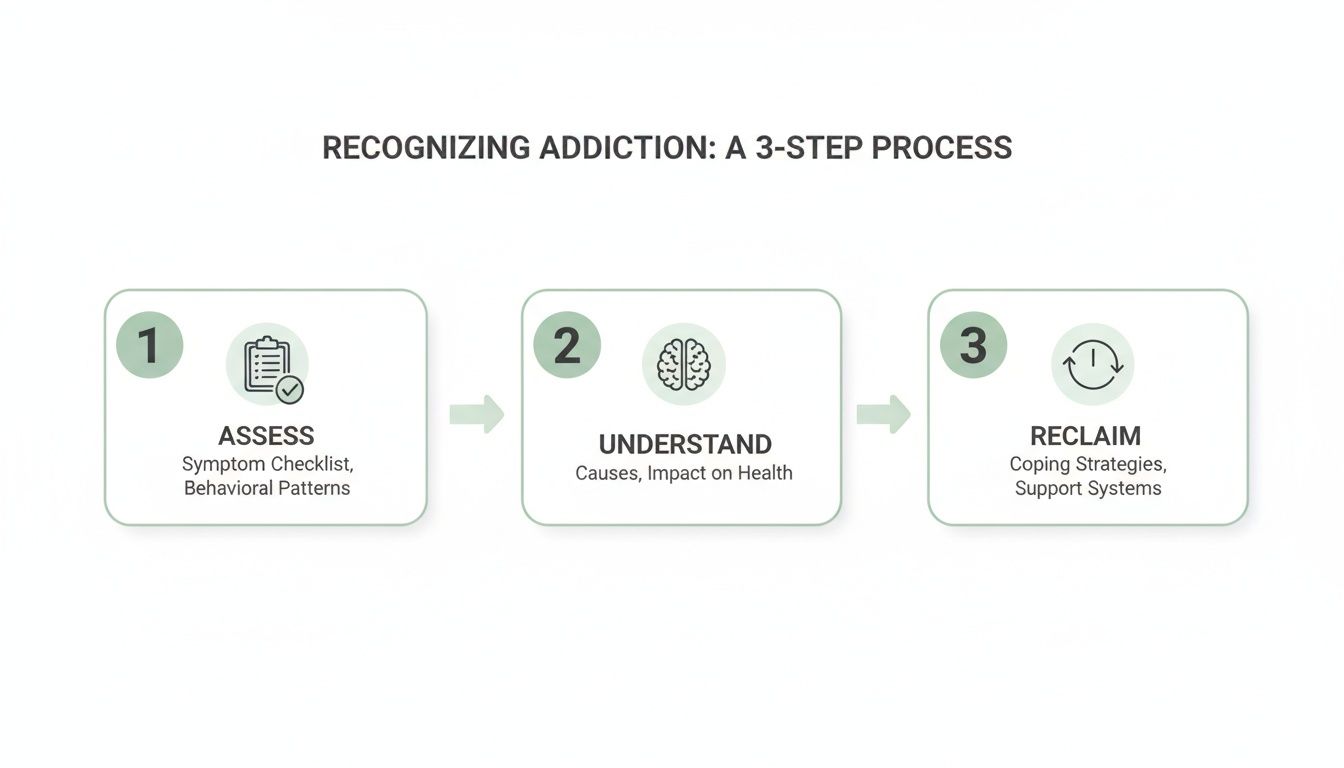
This guide boils the journey down into manageable stages: first assessing your current behaviors, then understanding the psychological drivers behind them, and finally, getting ready to reclaim your focus.
The Science Behind the Scroll
Ever wonder why it feels physically difficult to just put the phone down? The answer is pure brain chemistry. Social media platforms are masterfully designed to hijack your brain’s reward system, firing off a little hit of a chemical called dopamine with every single like, comment, and notification. This creates an incredibly powerful feedback loop.
This constant drip of immediate, bite-sized rewards conditions your brain to crave more, reinforcing the compulsion to check your phone again and again. It’s the very same neural circuitry involved in other compulsive behaviors. Over time, you can even build up a tolerance, needing more and more engagement to get that same fleeting feeling of satisfaction.
To really get a handle on your attachment, it helps to understand the difference between psychological vs. physical dependence, since what we’re dealing with here is primarily a behavioral challenge.
Key Behavioral Red Flags to Watch For
Figuring out if you have a problem goes way beyond just looking at your screen time stats. It’s about the quality of that time and the ripple effect it has on the rest of your life.
Quick Self-Assessment: Are You Addicted to Social Media?
Take a moment for an honest check-in. Answering these questions can help you gauge your level of dependency and spot common patterns that might be holding you back.
| Symptom or Behavior | Check If This Applies to You | What It Means |
|---|---|---|
| Mindless Scrolling | ☐ | You open an app without a real purpose and suddenly realize 30 minutes have vanished. |
| Neglecting Responsibilities | ☐ | You find yourself putting off work, chores, or school assignments to browse your feeds instead. |
| Anxiety When Disconnected | ☐ | You feel restless, irritable, or genuinely anxious if you can’t check your notifications. |
| Using It to Escape | ☐ | Your first instinct when feeling stressed, sad, or bored is to grab your phone to numb out. |
| Constant Comparison | ☐ | You often feel inadequate, jealous, or just plain bad about your own life after seeing others’ posts. |
| Failed “Cut-Back” Attempts | ☐ | You’ve tried to reduce your time on social media before but found yourself unable to stick with it. |
| Lying About Usage | ☐ | You downplay or hide how much time you actually spend on social media from others. |
| Losing Interest in Hobbies | ☐ | Activities you once enjoyed now seem less interesting than scrolling through your phone. |
How did you do? Seeing yourself in a few of these is common, but if you checked off several, it’s a clear signal that it’s time to make a change.
You are definitely not alone in this. The latest statistics show that over 210 million people worldwide are dealing with social media addiction. For those who feel the negative pull, taking a break can be incredibly powerful. In fact, studies show that completing just a 7-day detox can lead to a 47% drop in anxiety and loneliness.
This highlights the clear benefits of digital detox. You can dig deeper into how a temporary break boosts well-being and find more stats in our full guide.
A critical shift happens when you move from unconscious consumption to conscious awareness. Acknowledging that you use social media to avoid difficult feelings is the first step toward finding healthier, more effective coping strategies.
This initial self-assessment gives you the crucial baseline you need. It provides a clear “why” to power you through the practical steps ahead, turning a vague wish to “use my phone less” into a concrete plan for a more present and fulfilling life.
Designing Your Digital Environment for Success
Let’s be honest: beating social media addiction isn’t a battle of pure willpower. It’s a game of smart design. Your phone was engineered by experts to capture and hold your attention, so it’s time you engineered it right back. This is all about creating an environment where the healthier choice is the easiest one to make.
Instead of trying to white-knuckle your way through the temptation of an infinite scroll, you can build a system of digital guardrails. These are small, intentional tweaks to your devices that make better habits almost automatic, putting a bit of friction between you and the apps that drain your time and energy.

Ultimately, this is about making your technology work for you, not against you. The goal is to turn your phone from a constant source of distraction into a tool you pick up with a clear purpose.
Your Built-In Toolkit for Setting Boundaries
Some of the most powerful tools for managing your social media use are probably already on your phone. Both iOS and Android have surprisingly robust features designed to help you see exactly where your time is going and set firm limits. Using them is the most effective first step you can take.
Think of these features as your front line of defense. By setting automated limits, you take the daily self-negotiation—”just five more minutes”—completely out of the equation.
- iOS Screen Time: You’ll find this right in your iPhone’s settings. It lets you set daily time limits for specific apps (like TikTok) or entire categories (like “Social”). When your time is up, the app icon dims, and you have to consciously enter a passcode to keep going. It’s a simple but effective barrier.
- Android’s Digital Wellbeing: This is Google’s version, and it’s just as good. It has similar app timers and usage dashboards, but also a “Focus Mode” that pauses distracting apps with one tap and a “Wind Down” feature that turns your screen grayscale and silences notifications to help you prepare for sleep.
Using these tools isn’t a small thing. With 5.24 billion people projected to be on social media by 2025, an estimated 210 million are grappling with addiction. While 40% of young adults in the US admit to this dependency, the data shows a clear path forward: users who set a 30-60 minute daily cap with these built-in tools cut their usage by a staggering 50-70%.
Advanced Strategies for a Low-Distraction Environment
Once your daily limits are in place, you can add a few more layers to your strategy. These next tactics are designed to reduce the psychological pull of your device, making it less appealing for mindless scrolling and more of a functional tool.
The idea is to strip away the hyper-stimulating elements that make these apps so hard to put down. This helps rewire your brain’s association with your phone, turning it from a candy machine into a calculator.
Making Your Phone Less Appealing
- Go Grayscale: This is a game-changer. Removing the vibrant, attention-grabbing colors from your screen makes apps far less stimulating. That colorful Instagram feed becomes a bland, uninteresting gray, and you’d be surprised how quickly you lose interest. You can usually find this setting under “Accessibility.”
- Kill the Notifications: Be ruthless. Turn off every notification that isn’t from a human being you need to hear from, like calls or messages from key contacts. Every banner and buzz is a carefully designed interruption meant to pull you back in. You can always check your apps on your own schedule.
- Bury the Distractions: Move your social media apps off your main home screen. Stick them all in a folder on the very last page. That simple act of adding an extra swipe or two creates just enough friction to make you pause and ask, “Do I really need to open this right now?”
By strategically curating your digital environment, you are no longer fighting a constant battle against temptation. Instead, you’re creating a space that naturally guides you toward better focus and more intentional living.
Creating No-Phone Zones and Times
Finally, a crucial part of reclaiming your attention is establishing clear boundaries in the physical world. This means designating specific times and places where your phone simply isn’t welcome, allowing you to be fully present in your actual life. For a deeper look, check out our guide on how to decrease screen time with more easy-to-implement habits.
Start with these non-negotiable rules:
- The Bedroom: Get your phone out of the bedroom. Period. This is the single best thing you can do for your sleep quality, as it removes blue light exposure and the temptation for late-night scrolling. Buy a cheap alarm clock.
- The Dinner Table: Make meal times a screen-free zone, whether you’re eating alone or with family. It encourages mindful eating and makes real connection possible.
- Scheduled “Do Not Disturb”: Use your phone’s scheduling feature to automatically turn on “Do Not Disturb” during your most productive work hours or family time in the evening. This protects your focus when it matters most.
Swap the Scroll for Something Real
Setting digital limits is a great defensive strategy, but the real win in beating social media addiction comes from playing good offense. A successful break isn’t about creating a void of empty time. It’s about deliberately filling that newfound space with fulfilling, real-world experiences that actually matter. The idea is to trade the cheap, fleeting dopamine hits from notifications for sustainable rewards that build genuine confidence and connection.
First, you have to understand the powerful psychological loop you’re up against. Social media delivers instant, low-effort rewards. A single tap brings a flood of likes, comments, and fresh content, feeding your brain’s hunger for novelty and validation. To fight back, you need activities that offer a different, more substantial kind of reward—one that’s earned through effort and provides a lasting sense of accomplishment.

This isn’t just about finding a distraction; it’s about rebuilding your attention span and remembering what truly engages you away from a screen. It’s a return to the tangible world.
Rediscovering Your Real-World Interests
The first step is often the toughest: figuring out what to do with all those hours you used to burn scrolling. For many of us, social media has slowly crowded out old hobbies and interests. Now’s the time to bring them back or find entirely new ones.
Don’t pressure yourself to find the “perfect” hobby right away. Just think of this as an exploration phase. The only rule? It has to be an offline activity that requires your active participation.
Here are a few categories to get you started:
- Creative Pursuits: Try learning a musical instrument, painting, writing, or photography. These build skills over time and give you a clear sense of progress with tangible results you can see and hold.
- Physical Activities: Join a local sports league, start hiking, take up yoga, or just commit to daily walks in a park. Moving your body is a powerful antidote to the sedentary nature of scrolling and a natural mood booster.
- Learning and Skill-Building: Sign up for an in-person class, learn a new language with a tutor, or master a practical skill like cooking or woodworking. This engages your mind in a structured, rewarding way.
- Social Connection: Intentionally schedule coffee dates, game nights, or dinners with friends. Reinvesting in face-to-face relationships provides the genuine connection that social media can only imitate.
For anyone trying to break free from the endless cycle of checking and scrolling, learning how to stop compulsive behaviors is the most direct path to reclaiming your time and attention. Replacing a habit is almost always more effective than just trying to kill it.
The Power of Mindfulness in Rebuilding Focus
Mindfulness is your secret weapon for rewiring your brain. Chronic social media use demolishes our attention spans and trains us to constantly seek out the next new thing. Mindfulness practices, like meditation, do the exact opposite—they train your ability to focus your attention on purpose, without judgment.
Even just five to ten minutes of daily meditation can make a huge difference. It helps you become more aware of the impulse to grab your phone, giving you that crucial split second to pause and make a different choice.
The scale of this issue is staggering. By 2025, an estimated 210 million people globally will be addicted to social media, contributing to a 47% rise in anxiety and a 63% rise in depression. But proactive strategies show incredible promise. Studies reveal that combining mindfulness with physical exercise yields a 70% success rate among young adults, helping them slash usage by over three hours a day and boosting self-esteem.
The point of mindfulness isn’t to empty your mind. It’s to observe your thoughts and urges without letting them control you. When you feel the pull to scroll, you can simply acknowledge it—”Ah, there’s that restless feeling again”—and gently guide your focus back to the present moment.
Swapping Passive Consumption for Active Creation
One of the most profound shifts you can make is moving from a mindset of consumption to one of creation. Scrolling is inherently passive; you’re just absorbing content an algorithm serves you.
To counteract this, actively seek out activities where you are the one doing, making, or contributing.
| Passive Scrolling Habit | Active Replacement Activity |
|---|---|
| Watching cooking videos on TikTok | Actually trying a new recipe in your kitchen |
| Browsing travel photos on Instagram | Planning a weekend trip to a nearby town |
| Reading political arguments on Twitter | Volunteering for a local cause you care about |
| Looking at DIY projects on Pinterest | Starting a small project, like painting a room |
This reorientation has a powerful effect on your sense of agency. Instead of passively watching other people’s lives, you become the active protagonist in your own. This builds a deep, authentic confidence that no amount of online validation can ever replicate, making it a cornerstone strategy for how to overcome social media addiction for good.
Building a Support System for Lasting Change
Trying to break a social media addiction on your own can feel like a lonely battle. Honestly, going it alone is one of the fastest ways to slide right back into old scrolling habits. A solid support system isn’t just a “nice-to-have”—it’s often the single biggest predictor of whether you’ll stick with it for the long haul.
This is all about getting people in your corner who get what you’re trying to do and can cheer you on when your own motivation is running low. Building that network takes some real effort. Willpower eventually runs out, but having people to back you up is like having a backup generator for your motivation. It turns an internal struggle into a shared goal.

Turning Friends and Family into Allies
The people closest to you can be your biggest champions or, without meaning to, your biggest roadblocks. It all comes down to how you talk to them about it. Most people don’t really grasp the pull of social media addiction, so framing the conversation is everything.
Instead of a blunt “I’m quitting social media,” try explaining why you’re doing it. When they understand the positive changes you’re aiming for, they’re much more likely to offer real, meaningful support.
Here are a few ways to start that conversation:
- “I’ve realized I’m not always present when we’re hanging out, and I really want to fix that. I’m putting limits on my phone so I can be more engaged with you.”
- “I’m trying to get my focus back for work, so I’m cutting way back on social media. Could you help me stick to it by suggesting we do something offline instead of just scrolling?”
- “To be honest, all the scrolling has been making me feel pretty anxious. I’m trying to replace that habit with healthier stuff, and I’d really appreciate your support.”
By framing your goal around positive outcomes—like being more present or less anxious—you invite collaboration rather than judgment. You’re not just stopping a bad habit; you’re starting a better one.
The Accountability Partner Advantage
One of the most powerful moves you can make is finding an accountability partner. This is someone you check in with regularly, who is ideally working on a similar goal. It’s a different dynamic than just telling a friend; it’s a mutual pact built on shared progress and being honest about the struggles.
This kind of partnership gives you a unique mix of empathy and a kick in the pants. When you’re tempted to spend an hour on TikTok, just knowing you have to report back to someone can be a surprisingly strong deterrent. On the flip side, hearing about their wins can give you the boost you need to keep pushing forward.
What Makes a Great Accountability Partner?
A good partner can make all the difference. Look for someone who is:
| Essential Qualities | Why It Matters |
|---|---|
| Trustworthy and Non-Judgmental | You have to feel safe sharing both your wins and your slip-ups without feeling like you’re going to be shamed for it. |
| Has a Similar Goal | They get the specific challenges you’re facing because they’re right there in the trenches with you. |
| Good Communicator | Regular, honest check-ins are the whole point. This could be a quick daily text or a weekly phone call. |
This shared journey makes the whole process feel less isolating. It adds an external layer of commitment that reinforces your own internal drive.
To really solidify your new routines, pairing an accountability partner with one of the best habit-tracking apps can be a game-changer. It gives you a clear, visual record of your progress, which provides a solid structure for your check-ins and makes it easier to celebrate the small wins together.
How to Navigate Setbacks and Maintain Your Progress
Let’s be realistic for a moment. The path to breaking a social media habit isn’t a straight line. It’s messy. You’re going to have days where you fall back into a scrolling vortex for an hour when you only meant to check a single message. It happens.
The real test isn’t about achieving perfection. It’s about building the resilience to get back up after a slip-up without letting it derail your entire journey. Lasting change is never a one-and-done decision; it’s a series of course corrections.
When a relapse happens, the most destructive thing you can do is beat yourself up. That guilt spiral is what turns a minor setback into a full-blown failure. Instead, I want you to start thinking of these moments as data. A slip-up is just information—a clue that shows you exactly where your strategy needs a tune-up.
Identifying Your Personal Triggers
Compulsive scrolling rarely just happens. It’s almost always a reaction to something else going on under the surface, whether it’s an emotion you’re trying to avoid or a situation you’re trying to escape. Getting ahead of a relapse means figuring out what’s really pushing you to pick up your phone.
Think about the last time you got stuck in a feed. What was going on right before you opened the app? For most of us, the culprits fall into a few familiar buckets:
- Boredom: You hit a moment of stillness—waiting in line, a commercial break, a quiet house—and your brain screams for a quick hit of stimulation. Your phone is the easiest fix.
- Stress or Anxiety: Your thoughts are racing about a work deadline or a personal problem. Scrolling feels like hitting a pause button on your brain, offering a temporary—but effective—numbing sensation.
- Loneliness: You’re feeling disconnected or left out, and the curated feeds on social media create a flimsy illusion of connection that feels better than sitting with the silence.
- FOMO (Fear of Missing Out): A notification buzzes or you see a group of friends tagged in a photo, and a sudden urgency hits. You feel like you have to check in so you don’t get left behind.
Learning to recognize these feelings as they are happening is a total game-changer. It gives you a crucial moment to pause and ask, “What do I actually need right now?” instead of automatically reaching for your phone to treat the symptom.
A setback is not a sign of failure; it is a signal to adjust your strategy. The goal is to learn from each slip-up, making you stronger and more prepared for the next challenge.
Performing a Guilt-Free Digital Reset
Okay, so you just torched an hour on TikTok when you only planned for five minutes. The immediate temptation is to feel frustrated and think, “See? I can’t do this.”
Instead, perform a quick, guilt-free ‘digital reset’ to get back on track immediately. This isn’t about punishment. It’s about a swift, compassionate course correction.
- Acknowledge and Move On: Literally say it out loud: “Okay, that happened. I scrolled more than I wanted to. Now I’m done.” Don’t marinate in the guilt. Just name it and close the app.
- Engage in a High-Value Offline Activity: Right away, do something that makes you feel present and grounded. Go for a quick walk around the block, put on your favorite song and dance for three minutes, or do a few deep stretches. This immediately reinforces that your real-world actions are what really matter.
- Review Your ‘Why’: Take 30 seconds to remind yourself why you started this in the first place. Was it to sleep better? To be more present with your kids? To finally finish that book? Reconnecting with your core motivation is the most powerful reset button you have.
This simple process transforms a moment of weakness into an act of self-compassion and renewed commitment.
Your Relapse Prevention Plan
The best defense is a good offense. If you can anticipate your triggers, you can have a healthier, more fulfilling coping strategy locked and loaded for when you need it most. A proactive plan short-circuits the decision fatigue that leads to bad habits.
Use this table as a starting point to map out your own personal plan. Get specific. The more detailed you are, the more likely you are to actually follow through when you’re feeling vulnerable.
| Common Trigger | How It Feels | Proactive Strategy to Use Instead |
|---|---|---|
| Boredom | Restless, antsy, feeling like there’s “nothing to do.” | Keep a book or puzzle on your coffee table. Have a go-to podcast ready to play. Step outside and just look at the sky for five minutes. |
| Stress | Overwhelmed, anxious, thoughts racing. | Try the 4-7-8 breathing technique. Grab a notebook and brain-dump everything that’s stressing you out. Do a quick burst of intense exercise like jumping jacks. |
| Loneliness | Isolated, disconnected, craving interaction. | Call or send a voice note to a friend to make a plan. Go to a public place with ambient energy, like a coffee shop or a park. Listen to a conversational podcast. |
| Fatigue | Mentally drained, low energy, seeking passive entertainment. | Lie down and rest your eyes for 10 minutes (without your phone). Put on some calming music. Make a cup of herbal tea and just sit with it. |
This isn’t just about knowing what to do instead of scrolling; it’s about making the better choice the easier one. By planning these alternatives in advance, you remove the need for in-the-moment willpower. This strategic preparation is absolutely essential for anyone serious about how to overcome social media addiction for good.
As you start this journey to get your focus back, it’s totally normal for questions to pop up. Everyone’s path is a bit different, and knowing what to expect can make the whole process feel less daunting. Here are some straight-up answers to the questions we hear all the time.
How Long Does This Actually Take?
There’s no magic number here—it’s a different timeline for everyone. That said, most people start feeling real, tangible benefits within the first 7 to 14 days of setting firm boundaries. We’re talking better sleep, a noticeable drop in anxiety, things you can actually feel.
The first few weeks can feel like the toughest part. It’s the initial “detox” phase where your brain is adjusting and you’re building new habits from scratch. Getting those new routines to feel automatic, like brushing your teeth, can take a few months. Just remember, the goal is steady progress, not overnight perfection.
Should I Just Delete All My Social Media Apps?
This is a big one, and it really comes down to what feels right and sustainable for you.
- For some people, yes. A “hard reset” by deleting the apps is the only way to break a really strong compulsive cycle. It just yanks the temptation out by the roots.
- For others, that’s not realistic. Maybe your job, family, or social life genuinely requires you to be on there. In that case, a strategy of strict, well-defined limits is going to work much better.
If you’re on the fence, start with aggressive limits first. Use your phone’s built-in app timers, schedule specific check-in times (like 15 minutes right after work), and kill every single non-essential notification. If you’re still struggling to stick to it, then deleting the apps for a set period, like 30 days, is a powerful next move.
What if My Job Requires Me to Be on Social Media?
This is probably one of the most common hurdles we see. The key here is to build a rock-solid wall between your professional use and personal scrolling. You have to compartmentalize.
Treat social media like you would any other work tool, not like an endless slot machine. Do all your professional social media tasks on a desktop browser during specific, scheduled work hours. This one change helps you avoid the mindless, hypnotic scrolling that mobile apps are specifically designed to encourage.
If you can, use separate user accounts or even a different device just for work-related social media. This creates a clear mental and digital line between your job and your personal time, which is absolutely essential for preventing burnout.
How Do I Deal with FOMO When I Use Social Media Less?
The fear of missing out is a powerful, manufactured feeling that these platforms are designed to exploit. The best way to fight it isn’t by checking in more—it’s by building a real, offline life that you genuinely don’t want to miss out on.
When you’re completely absorbed in a hobby you love, spending real, quality time with friends, or just enjoying a quiet moment in nature, what’s happening on some random feed becomes background noise.
You have to reframe your thinking. You aren’t “missing out” on digital static; you are “opting in” to a more present, focused, and fulfilling life.
Ready to build a healthier relationship with your technology? The Digital Detox App offers a suite of simple, free tools designed to help you set mindful boundaries, improve your focus, and reclaim your time. Start your journey toward digital balance today at https://digitaldetoxapp.com.