How to Keep Focused at Work and Reclaim Your Productivity
To get anything meaningful done at work, you have to protect your attention from the constant barrage of interruptions. This isn’t about just “trying harder.” It’s about fundamentally changing how you work by embracing what’s known as deep work, a state of pure, distraction-free focus where you can truly perform at your best.
Mastering this is more than just a productivity hack. It’s a strategic shift that not only helps you get more done but also dramatically improves the quality of that work and cuts down on stress.
Why You Can’t Focus and How Deep Work Fixes It

If it feels like your attention is being yanked in a dozen different directions at once, you’re not imagining things. The modern workplace is practically an obstacle course for concentration, with an endless stream of notifications, emails, and “quick questions” chipping away at your focus.
This isn’t just a minor annoyance; it’s a massive drain on your productivity and well-being. Every time you’re pulled away from your main task, your brain is forced into a context switch. It has to disengage from one thing and completely re-engage with another. That mental gear-shifting comes at a steep price.
The True Cost of Distractions
Think about this all-too-common scenario: You’re deep in the zone, analyzing a complex report, when a chat notification pops up. It’s a simple question that takes just a minute to answer. No big deal, right?
Wrong. The real damage isn’t the 60 seconds you spent replying. It’s the agonizingly long time it takes to get back to that same level of intense concentration you had before.
Research consistently shows that after an interruption, it can take an average of 15–23 minutes to fully get back on track. That means a single, harmless-looking notification can easily wipe out nearly half an hour of productive work. Multiply that by the dozens of interruptions in a typical day, and it’s no wonder you feel busy but not productive.
Introducing Deep Work vs. Shallow Work: A Breakdown
This is where the concept of “deep work” becomes an absolute game-changer. It’s the ability to focus without distraction on a cognitively demanding task. It’s that state of intense concentration that pushes your abilities to their limit, allowing you to produce high-value work and sharpen your skills. The opposite is “shallow work”—tasks that are logistical, non-demanding, and often performed while distracted.
Here’s a comparison to clarify the dynamic:
| Aspect | Deep Work | Shallow Work |
|---|---|---|
| Cognitive Strain | High (pushes your skills) | Low (can be done on autopilot) |
| Value Created | High (hard to replicate) | Low (easy to replicate) |
| Examples | Writing a strategic plan, coding a new feature, complex data analysis. | Answering routine emails, scheduling meetings, responding to simple chats. |
| Implication | Drives career growth, innovation, and significant results. | Necessary for operations, but creates little long-term value. |
Deep work isn’t about working longer hours; it’s about making the hours you do work count. It’s the perfect antidote to the fragmented, shallow work that our always-on culture encourages.
Embracing this approach brings real, tangible benefits that go way beyond just checking items off your to-do list:
- Higher Quality Output: When you’re fully immersed, you produce better, more thoughtful, and more creative work. Simple as that.
- Increased Productivity: Employees who carve out dedicated time for deep work can boost their individual productivity by roughly 20–30% compared to those stuck in a reactive, fragmented schedule. You can learn more about these workplace productivity findings.
- Reduced Stress and Burnout: Taking control of your schedule and minimizing the constant need to react reduces the mental fatigue that leads directly to burnout.
- Greater Job Satisfaction: There’s a deep sense of fulfillment that comes from producing high-quality work and feeling a real sense of accomplishment.
Learning how to stay focused at work is a fundamental shift in how you approach your professional life. By fiercely protecting your attention, you reclaim control over both your time and your output.
Design a Workspace That Defends Your Attention
Your physical surroundings are not neutral. They’re either helping you concentrate or actively sabotaging your efforts. Every object, every sound, and every digital ping is a vote for or against your focus. Turning your workspace into a fortress of concentration is one of the most powerful moves you can make.
And this isn’t just for those lucky enough to have a private home office. Whether you’re in a chaotic open-plan space, a shared corner, or a quiet room, you can absolutely engineer your environment to protect your attention.
The core idea is simple: make it harder to get distracted and easier to do the work that actually matters.
Audit Your Physical Space
Let’s start with what you can see and hear. Is your desk facing a hallway with constant foot traffic? Are you unwillingly part of every conversation happening around you? Getting a handle on these elements is your first line of defense.
Even tiny adjustments can have a massive impact on your ability to stay in the zone. Try these:
- Control the Sound: A good pair of noise-canceling headphones is non-negotiable in a loud office. They are the universal symbol for “I’m busy” and create an instant bubble of quiet, even in the middle of chaos.
- Optimize Your View: If you have any say in it, position your desk to face a wall or a window. This one change eliminates the constant visual noise of people walking by, which our brains are hardwired to track. It’s a simple, powerful fix.
- Signal Your Status: Use a visual cue to let people know you’re in deep work. It doesn’t have to be aggressive—a small, physical sign on your desk or monitor can politely tell colleagues that now isn’t a good time for interruptions.
Taking these steps cuts down on the external static competing for your attention, making it much easier to lock in on what’s in front of you.
Tame Your Digital Environment
Your digital workspace is just as important as your physical one—and honestly, it’s usually the bigger source of interruptions. Sure, turning off notifications is a great start, but creating a truly distraction-proof digital setup requires a bit more intention. Think of it as digital minimalism for getting things done.
You want to build a digital environment where your work is the easiest, most appealing option available. This means creating deliberate friction for time-wasting sites and streamlining your workflow to slash mental clutter.
Your digital workspace should serve your goals, not the goals of app developers who want your attention. By curating your tools and access, you reclaim control over your focus.
To make this happen, you have to be deliberate. One of the most effective strategies is to consciously work on your overall relationship with screens, which builds up your resistance to digital temptations during work hours. For some practical ideas on this, check out our guide on how to decrease your screen time.
Finally, build a system that works for you by performing a digital audit. Here’s a quick checklist to get you started:
- Use Browser Blockers: Install an extension like Freedom or LeechBlock to block access to social media, news sites, and other black holes of attention during your work hours. Set it and forget it.
- Create Separate Profiles: On your computer, set up a “Work” user profile that only has the apps, bookmarks, and tools you need for your job. When the workday is over, switch to a “Personal” profile for everything else. This separation is a game-changer.
- Organize Your Desktop: A desktop cluttered with dozens of random files creates a tiny bit of cognitive friction every time you see it. Tidy up. Create a simple, logical folder structure and keep that desktop as clear as possible.
Master Your Time with Proven Focus Frameworks
Once your workspace is set up to defend your attention, the next layer of protection is getting smart about how you manage your time. Let’s be honest, even the most perfect environment can’t save you from the siren song of multitasking or the sheer dread of a massive project. Think of proven focus techniques as the operating system for your productivity—they give you the rules and boundaries you need to do your best work.
Instead of white-knuckling it with willpower alone, these frameworks build a structure that makes deep focus the path of least resistance. They’re designed to help you slice overwhelming tasks into manageable bites, fiercely protect your most productive hours, and, most importantly, train your brain to concentrate for longer stretches.
This flowchart can help you quickly diagnose whether your current setup is helping or hurting your focus, pointing you toward immediate fixes for both your physical space and your digital one.
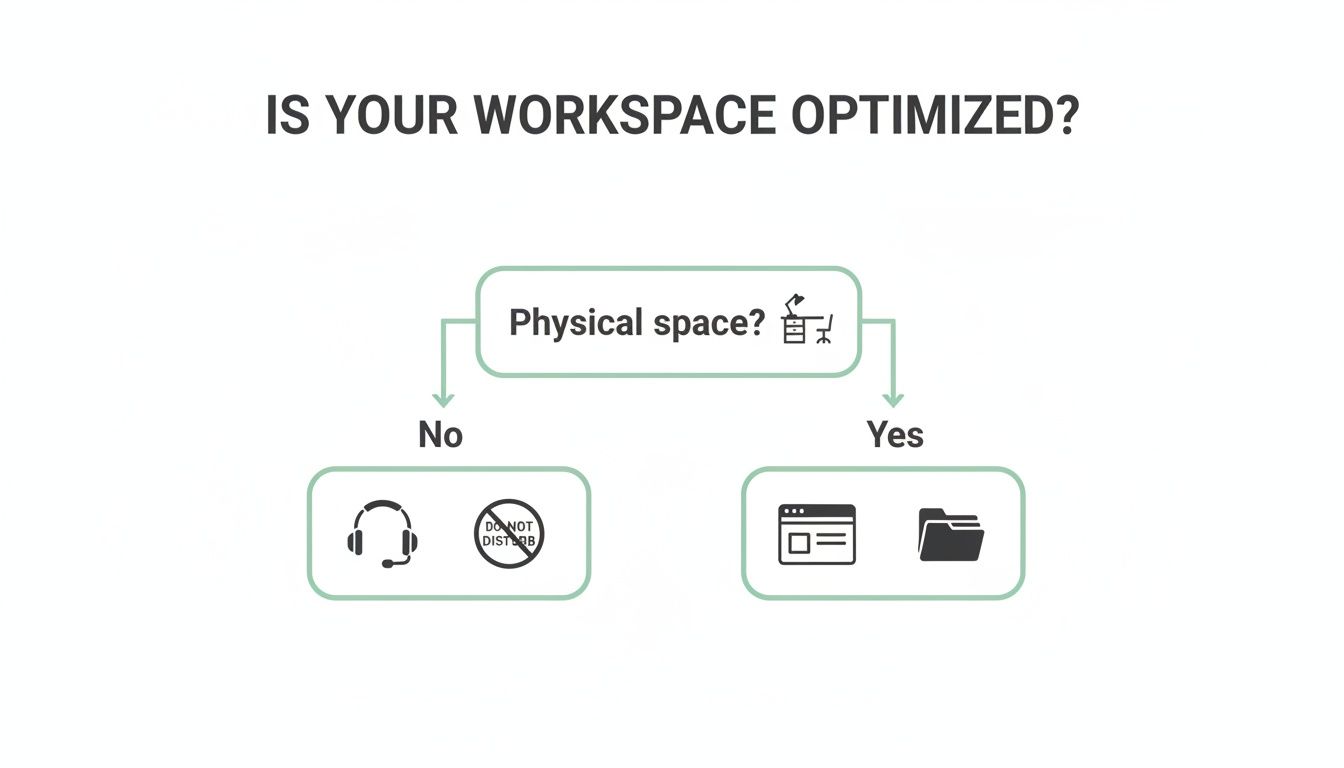
The big takeaway here is that focus is a two-front battle. You have to tackle the physical interruptions (like a noisy coworker) and the digital chaos (like a messy desktop) to really hit your stride.
Embrace Single-Tasking Over Multitasking
The biggest lie of modern work is that multitasking makes you more efficient. It’s simply not true. Every time you juggle multiple tasks, your brain is forced to rapidly switch contexts. This creates a kind of cognitive friction that not only slows you down but also spikes your error rate.
Single-tasking is the deceptively simple, incredibly powerful alternative. You give one task your undivided attention until it’s either finished or you hit a planned stopping point. This doesn’t just sharpen your concentration; it dramatically elevates the quality of your work.
For example, instead of trying to write an email while you’re on a team call, commit your full attention to the meeting. You’ll catch nuances you would have missed, contribute more thoughtfully, and probably save yourself from sending a “just to clarify…” email later.
The Pomodoro Technique for Bite-Sized Focus
For those huge, intimidating projects that make you want to go get another coffee, the Pomodoro Technique is a total game-changer. It’s a simple, cyclical system that breaks your work into manageable 25-minute intervals, separated by short 5-minute breaks.
The psychology behind it is brilliant. A 25-minute sprint feels doable, which is often all you need to overcome procrastination. The mandatory break prevents you from burning out and gives your brain a chance to reset before diving back in. After four of these “pomodoros,” you take a longer, more substantial break of 15-30 minutes.
This technique isn’t just about managing time; it’s about managing your energy. It creates a sustainable rhythm of intense focus followed by intentional rest, which is the key to high-level performance day after day.
Time Blocking to Proactively Own Your Day
While the Pomodoro Technique is fantastic for managing individual tasks, time blocking is about structuring your entire day. With this method, you schedule every part of your day—from deep work sessions to checking emails and taking a lunch break—into specific blocks on your calendar.
This simple act shifts your entire workflow from reactive to proactive. Instead of letting your inbox run your day, you’ve already decided what’s important and carved out protected time for it. This is how you guarantee your most critical, high-focus tasks get the prime real estate on your calendar they deserve. When you start to apply different business process improvement techniques to your daily schedule, you’ll find that time blocking becomes even more powerful.
Choosing Your Focus Technique: A Comparative Analysis
So, which one of these is right for you? It really depends on your personal work style, the type of tasks you do, and the demands of your role. There’s no single “best” method, only the one that works best for you.
This table breaks down the three techniques with a direct comparison of their dynamics and benefits:
| Technique | Best For | How It Works | Key Benefit |
|---|---|---|---|
| Pomodoro Technique | Creatives, procrastinators, and anyone facing long, open-ended tasks. | Work in 25-minute focused sprints with 5-minute breaks. | Smashes through mental resistance and prevents burnout on marathon projects. |
| Time Blocking | Managers, people with varied duties, and anyone craving more structure. | Schedule every part of your day into blocks on your calendar. | Protects your deep work time and stops you from living in your inbox all day. |
| Single-Tasking | Everyone. This is more of a foundational mindset than a complex technique. | Focus on one thing at a time until it’s done. | Produces higher-quality work with fewer mistakes and way less mental fatigue. |
The best approach is often a hybrid. You might use time blocking to structure your week, then use the Pomodoro Technique within a “deep work” block to tackle a specific project. The key is to experiment and find a rhythm that helps you consistently do your best work.
The Hidden Power of Strategic Breaks
It feels almost counterintuitive, doesn’t it? The idea that to get more done, you should… stop working. But the relentless push for productivity, the “always-on” hustle culture, has sold us a dangerous myth: that more hours automatically equal better results.
They don’t. Pushing through mental exhaustion is a fast track to burnout and sloppy, regrettable mistakes. Real high-performers aren’t just workhorses; they’re masters of managing their energy, and that means taking strategic rest seriously.
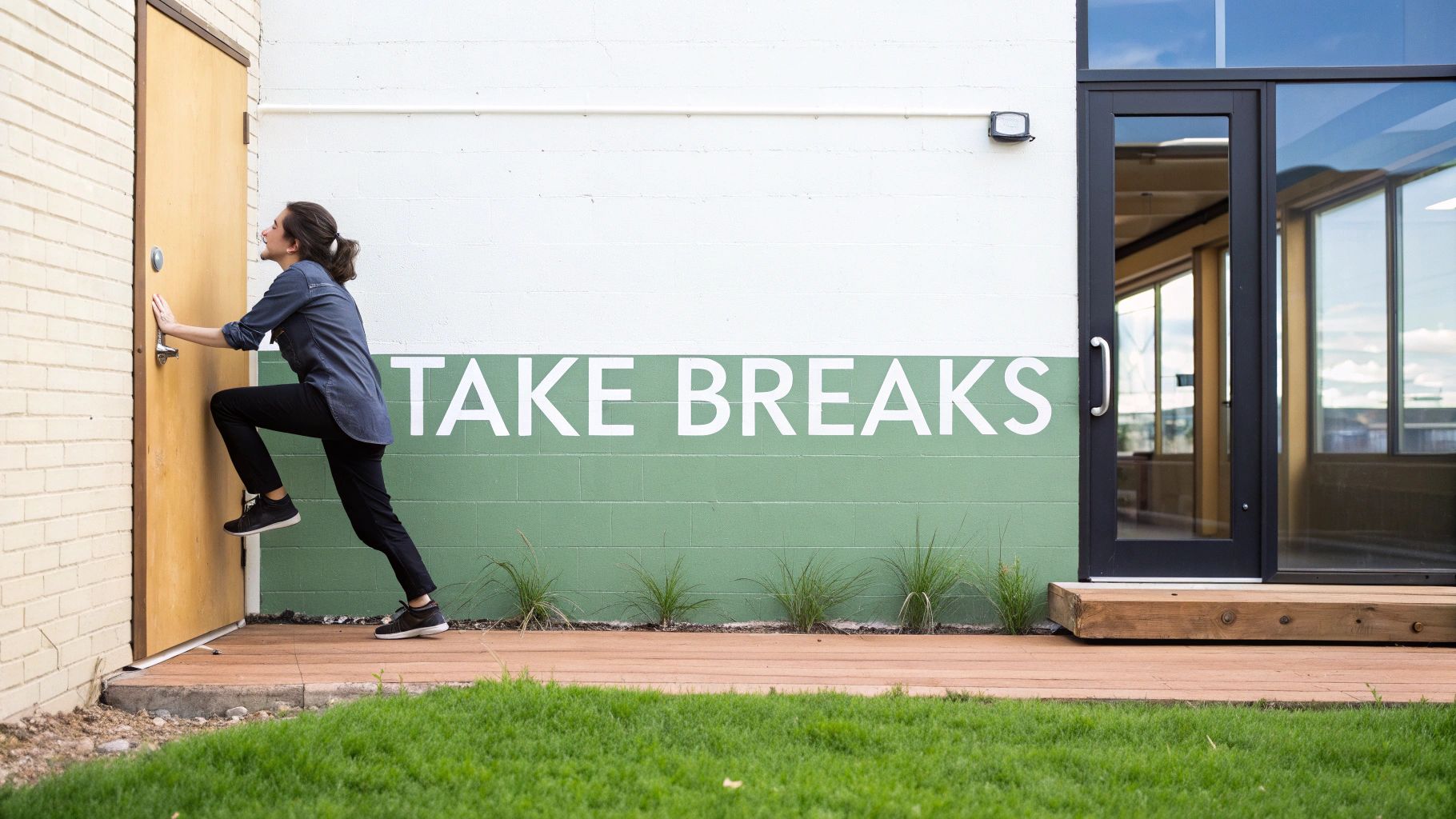
Think of your brain like a muscle. After a period of intense, focused effort, it gets tired. This state, which researchers call cognitive fatigue, is the reason your sharp focus starts to feel blurry and your mind begins to wander after about an hour of deep work. Strategic breaks are the essential recovery periods that let your brain recharge, making your next work session far more effective.
The Science of Effective Rest: Active vs. Passive Breaks
Here’s the catch: not all breaks are created equal. Mindlessly scrolling through a social media feed might feel like a break, but it’s often just swapping one form of cognitive load for another. It doesn’t restore your focus; it just distracts you with a flood of low-quality information. This is a passive break that offers minimal cognitive recovery. An active break, by contrast, intentionally disengages the parts of your brain used for work.
Large-scale research on worker activity backs this up. The most consistently productive employees aren’t the ones chained to their desks for hours. Instead, they work in a natural rhythm of intense focus followed by genuine rest. The data points to a surprisingly specific pattern: roughly 52 minutes of work followed by a 17-minute break. This cycle was found to preserve cognitive performance throughout the day. You can dig into more of these fascinating workplace productivity statistics yourself.
This really highlights a key dynamic: the quality of your rest directly fuels the quality of your next work sprint.
Making Your Breaks Count
So, what does a truly restorative break look like? Simple. The goal is to do something that’s low-demand on your brain and, ideally, gets you away from a screen. The key is finding small activities that create a genuine mental disconnect from your work.
Here are a few actionable ideas for your next break:
- Move Your Body: Just stand up. Do a few light stretches. Take a quick walk, even if it’s just to the kitchen and back. Physical movement is fantastic for boosting blood flow to the brain.
- Hydrate and Refuel: Grab a glass of water or a healthy snack. It’s amazing how often that “afternoon slump” is just your body telling you it’s dehydrated.
- Disconnect Digitally: Put your phone away. I know, the temptation to check notifications is incredibly strong, but resisting it is critical for a real mental reset. If this is a major struggle, looking into smart phone alternatives can offer practical ways to create that much-needed distance.
- Practice Mindfulness: You don’t have to be a zen master. Just a few minutes of quiet meditation or some simple deep-breathing exercises can do wonders to calm your mind and sharpen your concentration when you return.
The purpose of a break is not to escape your work; it’s to prepare you to return to it with renewed energy and clarity. Think of it as a strategic tool, not a guilty pleasure.
By intentionally building these restorative pauses into your day, you create a sustainable rhythm for productivity. This approach is absolutely fundamental to learning how to keep focused at work for the long haul, helping you end the day with energy left in the tank.
Build Sustainable Focus Habits for Long-Term Success
All the techniques we’ve covered so far are powerful, but they’re only temporary fixes without a solid foundation. True, lasting focus isn’t a switch you can just flip. It’s a muscle you have to build through consistent, intentional habits that eventually become second nature.
This is where we move from quick wins to a permanent upgrade in how you work and live. By creating simple but powerful routines, you’re training your brain to know when it’s time to concentrate and when it’s time to rest. This makes focus less of a struggle and more of an automatic state.
Create a Clear Work-Life Boundary
One of the most effective ways I’ve found to protect my focus is to create a hard stop to the workday. It sounds simple, but it’s a game-changer. When work bleeds into your personal time, your brain never truly gets to switch off and recharge, leaving you feeling drained and unfocused the next morning.
The solution is what I call a shutdown ritual. This is a short, consistent series of actions you take at the end of each day to signal that work is officially over.
A shutdown ritual is more than just closing your laptop. It’s a psychological cue that gives your brain permission to stop thinking about work, slashing after-hours stress and preventing burnout.
Your ritual doesn’t need to be complicated, but it does need to be consistent. Here’s a simple one to get you started:
- Review and Plan: Spend the last 15 minutes of your day looking over what you accomplished and—more importantly—identifying your top 1 to 3 priorities for tomorrow. This single step eliminates that dreaded morning decision fatigue.
- Tidy Your Space: Take a minute to organize your physical and digital desktops. A clean slate for the next day really does reduce mental clutter.
- Say a Closing Phrase: Verbally or mentally say something like, “Work is done for the day.” It might feel a bit silly at first, but this small act reinforces the boundary in a surprisingly powerful way.
Build Foundational Pillars of Focus
Your ability to concentrate isn’t just about what you do at your desk; it’s deeply connected to your overall well-being. Think of it like a three-legged stool. If one leg is wobbly, the whole thing is unstable. The three foundational pillars of focus—sleep, nutrition, and mindfulness—have a massive impact on your cognitive performance.
- Prioritize Sleep: This one is non-negotiable. Lack of quality sleep absolutely destroys focus. Aim for 7-9 hours a night and try to maintain a consistent sleep schedule, even on weekends.
- Fuel Your Brain: Your brain consumes about 20% of your body’s calories. Feed it with nutrient-dense foods, stay hydrated, and avoid those sugary snacks that lead to the inevitable energy crash right when you need to be sharp.
- Practice Mindfulness: You don’t need to meditate for an hour a day. Just a few minutes of focused breathing can calm your nervous system and dramatically improve your ability to redirect your attention when it wanders.
Trying to integrate all of this at once can feel overwhelming. A great approach is habit stacking, where you link a new habit to an existing one. For example, you could practice two minutes of mindfulness right after your morning coffee. You can explore more powerful habit stacking examples to make these changes feel almost effortless.
For a deeper dive, it can also be helpful to explore strategies for enhancing focus from specialized resources. By building these small, consistent habits, you create a powerful support system for long-term concentration and success.
Got Questions About Staying Focused? We’ve Got Answers.
Putting these focus strategies into practice is one thing. Making them stick when a deadline is screaming and your office sounds like a construction zone is another entirely. It’s totally normal to hit a few snags.
Let’s tackle some of the most common focus roadblocks I hear about, with solutions you can actually use.
“How Can I Possibly Focus in a Loud, Open-Plan Office?”
I get this one a lot. In a busy open office, you need to build a fortress of focus, and it’s a multi-layered defense.
First, your non-negotiable starting point: invest in a pair of high-quality noise-canceling headphones. They create a personal bubble of quiet and, more importantly, they’re the universal symbol for “I’m in the zone, please don’t interrupt.”
Next, think visual cues. Even a small sign on your desk can work wonders. I’ve seen people use everything from a little flag to a specific desk lamp that they turn on when they’re in a deep work session. And don’t be afraid to get strategic with your schedule. Try to tackle your most demanding tasks during the naturally quieter periods, like first thing in the morning. When you’re on a really tight deadline, booking a small meeting room for an hour of pure, uninterrupted work is a total game-changer.
“My Job Requires Me to Be Constantly Available. What Then?”
This is a classic challenge for roles in customer support, project management, or any field that demands high responsiveness. The goal here isn’t to become a ghost; it’s to batch your focus.
Instead of aiming for a long, two-hour stretch of unbroken concentration (which is probably unrealistic), schedule shorter, more frequent deep work blocks. Think three 45-minute sessions instead of two 90-minute ones. It’s far more manageable.
The key is communicating this schedule to your team. A simple Slack status like, “Heads down until 10:45 AM, will check all messages then,” sets clear expectations. This creates a predictable rhythm where your team knows they can rely on you, and you get to protect your focus without dropping the ball.
The goal isn’t to become unavailable, but to become predictably available. This simple shift allows you to control your schedule instead of letting your schedule control you.
“What if I Get Distracted by My Own Thoughts?”
Ah, the internal distractions. Honestly, these are often the toughest ones to wrangle. Your brain is an idea machine, and it doesn’t care that you’re trying to finish a report.
A surprisingly powerful technique is the distraction notepad. Keep a physical notebook or even a simple text file open on your desk for this exact purpose.
The moment a random thought, a new idea, or a forgotten to-do item pops into your head, just quickly jot it down. Don’t analyze it, don’t judge it—just capture it. This simple act tells your brain, “I’ve got this, it won’t be forgotten,” which allows you to release the thought and get right back to the task at a hand. You can then go through that list during a scheduled break. Over time, this trains your mind to stop derailing your focus.
Building a healthier relationship with your work and technology is a journey, not a destination. For simple, free tools to help you unplug, recharge, and find your digital balance, check out the apps from Digital Detox App at https://digitaldetoxapp.com.